China Statistical Yearbook 2023

China Statistical Yearbook 2023 Download

Yearbook title:中国统计年鉴20223
Yearbook English title:China Statistical Yearbook 2023
Published Date :2023.09
ISBN:978-7-5230-0190-5
Language : English and Chinese bilingual
Availability : Printed Version;Electronic Version(PDF Version)
China Statistical Yearbook 2023

Ⅰ. China Statistical Yearbook 3023 is an annual statistical publication, which reflects comprehensively the economic and social development of China. It covers data for 2022 and key statistical data in recent years and some historically important years at the national level and the local levels of province, autonomous region and municipality directly under the Central Government.
Ⅱ. The Yearbook contains twenty-eight chapters: 1. General Survey; 2. Population; 3. National Accounts; 4. Employment and Wages; 5. Prices; 6. People’s Livelihoods; 7. Government Finance; 8. Resources and Environment; 9. Energ;10. Investment in Fixed Assets; 11. International Trade and Economic Cooperation; 12. Agriculture; 13. Industry; 14. Construction; 15. Wholesale and
Retail Trades; 16厂Transport. Postal and Telecommunication Services, and Software Industry; 17. Hotels, Catering Services and Tourism; 18. Financial Intermediation; l9. Real Estate; 20. Science and Technology; 21. Education; 22. Public Health and Social Services; 23. Culture and Sports; 24. Public Management, Social Security and Social Organizations; 25. Urban, Rural and Regional
Development; 26. Main Social and Economic Indicators of Hong Kong Special Administrative Region; 27. Main Social and Economic Indicators of Macao Special Administrative Region; 28. Main Social and Economic Indicators of Taiwan Province. One chapter listed as Appendix is Main Social and Economic Indicators of Other Countries/Regions.
To facilitate readers, the Brief Introduction at the beginning of each chapter provides a summary of the main contents of the chapter, data sources, statistical coverage, statistical methods and historical changes. At the end of each chapter, Explanatory Notes on Main Statistical Indicators are included.
Ⅲ. The national data in this book do not include those of the Hong Kong Special Administrative Region, the Macao Special Administrative Region and Taiwan Province, except for the divisions of administrative areas, forest resources and otherwise specified.
In accordance with the principles set down in the Basic Law of Hong Kong Special Administrative Region, and the Basic Law of Macao Special Administrative Region;statistically Hong Kong, Macao and the mainland of China are three mutually independent
regions. each following its own and different statistical systems and legal provisions in conducting statistical operation independently.
Statistics on the Hong Kong Special Administrative Region and the Macao Special Administrative Region as included in this
yearbook are provided by the Census and Statistics Department of the Government of Hong Kong Special Administrative Region and
the Statistics and Census Service of the Government of Macao Special Administrative Region respectively; and are edited by the
National Bureau of Statistics.
Ⅳ Eastern region, central region, western region and northeastern region in the Yearbook are divided as following:
Eastern region with 10 provinces (municipalities) includes: Beijing, Tianjin, Hebei, Shanghai, Jiangsu, Zhejiang, Fujian,Shandong, Guangdong and Hainan;
Central region with 6 provinces includes: Shanxi, Anhui, Jiangxi, Henan, Hubei and Hunan;
Western region with 12 provinces (autonomous regions and municipalities) includes: Inner Mongolia, Guangxi, Chongqing,Sichuan. Guizhou. Yunnan, Tibet, Shaanxi, Gansu. Qinghai. Ningxia and Xinjiang;
Northeastern region with 3 provinces includes: Liaoning, Jilin and Heilongjiang.
Ⅴ The units of measurement used in the Yearbook are international standard measurement units, and newly published and implemented Product Categories are uniformly used.
Ⅵ. For updated historical data, please refer to the newly published version of the Yearbook. Statistical discrepancies on totals and relative figures due to rounding are not adjusted in the Yearbook.
Ⅶ. Notations used in the Yearbook: (blank space) indicates that the data are unknown, or are not available;”#”indicates a major breakdown of the total; and”*”or”①”indicates footnotes at the end of the table. For notations in the chapters of data on
Hong Kong SAR and Macao SAR, please refer to the brief introduction or explanation in the relevant chapters.
Ⅷ. In comparison with China Statistical Yearbook 202?, following revisions have been made in this new version in terms of the statistical contents and in editing. In the chapter on “General Survey”, the meaning of number of divisions at township level is changed. In the chapter on “Resources and Environment”,the indicator “major marine disasters” increase the data of damaged
seawall and revetment. In the chapter on “Industry”, the economic benefits of private industrial enterprises in the “other mining industry” industry, foreign investment in the “tobacco product industry” and industrial enterprises invested by Hong Kong, Macao,and Taiwan businessmen have been added. In the chapter on “Science and Technology”, the indicator of R&D and related activities of high-tech industry (manufacturing) enterprises is added. In the chapter on “Education”, the indicator of vocational undergraduates by region is added. In the chapter on “Science and Technology”, the indicator of R&D and related activities of high-tech industry (manufacturing) enterprises is added. In the chapter on “Public Health and Social Services”, the indicator of vocational undergraduates by region is added. the meaning of patients discharged per bed, inpatients per 100 outpatient and emergency visits and per capita health expendiRire are changed. In the chapter on “Public Management, Social Security and Social Organizations”, the indicator of cases of endangering public safety, disrupting the order of the socialist market economy, infringing on citizens’ personal and democratic rights. infringing on property, disrupting social management order, and other types of criminal protest cases handled by People’s Procuratorate by region are added. The indicator of expenses of birth insurance is added. The meaning of retired personnel is changed.
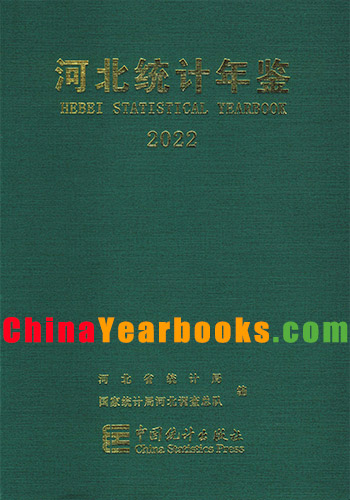
Hebei Statistical Yearbook 2022

Hebei Statistical Yearbook 2022 Download

Yearbook title:河北统计年鉴2022
Yearbook English title:Hebei Statistical Yearbook 2022
Published Date :2023.03
ISBN:978-7-5230-0058-8
Language : English and Chinese bilingual
Availability : Printed Version;Electronic Version(PDF Version)

Hebei Statistical Yearbook 2022

I.Hebei Statistical Yearbook-2022 is a systematic collection of economic and social statistical data of the province and cities,counties(cities and districts) in 2021,as well as the main statistical data of the province in each major period since 1978.It is an informative annual publication comprehensively reflecting the national economic and social development of Hebei.

Ⅱ.The Yearbook includes feature articles,statistical data and appendix.

Feature articles include Statistical Communique of National Economic and Social Development of Hebei Province in 2021,some of the data in the bulletin are dispatches.
The content of statistical data consists of 24 articles,namely:1.General Survey;2.Population;3.National Economic Accounts;4.Employment and Wages;5.Price;6.People’s Livelihoods;7.Government Finance,Banking and Insurance;8.Energy and Environment;9.Investment in Fixed Assets;10.Foreign Economic Relations and Trade;11.Agriculture;12.Industry;13.Construction;14.Wholesale and Retail;15.Transport,Post and Telecommunications;16.Hotels,Catering Services and Tourism;17.Real Estate;18.Science and Technology;19.Education;20.Health and Social Services;21.Culture and Sports;22.Public Management and Social Security;23.City Profiles;24.Main Indicators of Counties(Cities and Districts at County Level).

For the convenience of readers,a brief description is provided before each chapter,which gives an overview of the main contents,data sources,statistical scope,statistical methods and historical changes of this chapter.At the end of the article,there is an explanation of the main statistical indicators.

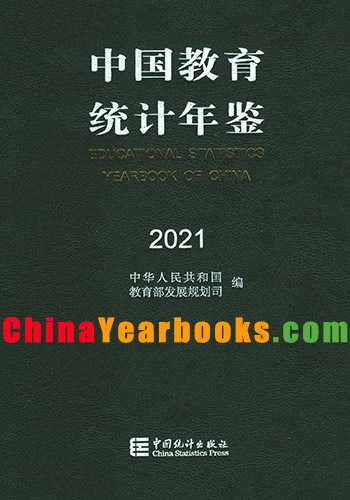
Educational Statistics Yearbook of China 2021

Educational Statistics Yearbook of China 2021 Download

Yearbook title:中国教育统计年鉴2021
Yearbook English title:Educational Statistics Yearbook of China 2020
Published Date :2022.12
ISBN:978-7-5230-0045-8
Language : English and Chinese bilingual
Availability : Printed Version;Electronic Version(PDF Version)

Educational Statistics Yearbook of China 2021

The Educational Statistics Yearbook of China(2021) is an informational yearbook comprehensively reflecting the development of the educational undertaking of the People’s Republic of China, and it was compiled by the Department of Development and Planning of Chinese Ministry of Education, based on the synthetic statistical returns relating to schools of various types and levels completed by the Provincial Education Department(or the Educational Commissions ) of the provincial governments and the governments of various autonomous regions and municipalities directly under the State Council. All data were processed and calculated using Computers by the Educational Management Information Center of Ministry of Education.
This yearbook is composed of following parts:summary tables,higher education,secondary education,primary education,special education, preprimary education,geographical distribution of schools by type and level,Physical Facilities,Scientific Research Activities,etc. The yearbook is a requisite reference for all departments concerned with the study of educational reform and development.
The national statistics covered in this yearbookdo not include data from the Hong Kong Special Administrative Region,the Macao Special Administrative Region,and Taiwan Region. Data from the Skilled Workers School administered by the Ministry of Human Resources and Social Security of the People’s Republic of China are not included in this yearbook. The Chinese-Foreign Cooperation in Running Schools with Legal Personality refers to Chinese一Foreign Cooperation in Running Schools and Cooperation in Running Schools
between mainland educational institutions and educational institutions from the HKSAR,the MSAR or Taiwan with Legal Personality. All data, without specific notes,were collected in 2021.
Symbol instructions:“一”indicates that the data of this statistical indicator are unknown or unavailable;“*”or“①”indicates that there is an annotation below the table.

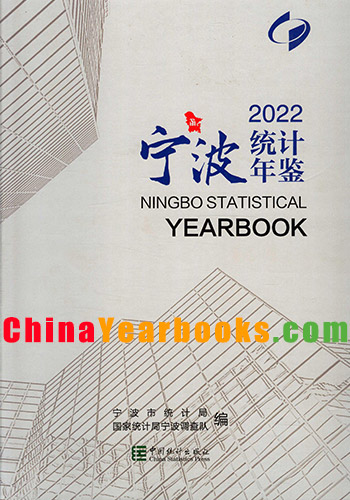
Ningbo Statistical Yearbook 2022

Ningbo Statistical Yearbook 2022 Download

Yearbook title:宁波统计年鉴2022
Yearbook English title:Ningbo Statistical Yearbook 2022
Published Date :2022.11
ISBN:978-7-5230-0064-9
Language : English and Chinese bilingual
Availability : Printed Version;Electronic Version(PDF Version)

Ningbo Statistical Yearbook 2022

Ⅰ.Ningbo Statistical Yearbook 2022 is an annual publication which provides comprehensive and systematic data covering the economic,technological and social development in Ningbo Municipality in 2021.This yearbook uses the Chinese and English mix typesetting the way. Ⅱ.This yearbook has made the adjustment in the content arrangement order.This yearbook is comprised of 14 parts including:1.Brief Introduction of 2021 Ningbo National Economy and Social Development;2.General Survey;3.Population and labor force;4.National Economic Accounting;5.Finance,Banking,Insurance and Securities;6.Price Index and People’s Livelihood;7.Agriculture;8.Industry,Energy Consumption and Electricity;9.Investment in Fixed Assets and Construction;10.Port,Transportation,Post and Telecommunication;11.Domestic Trade and Catering Trade;12.Foreign Trade and Tourism;13.Education,Culture,Public Health and Sports,Science and Technology;14.Civil Facilities,Environmental Protection,Civil Affairs,Judicature and Others.Major statistical indicators at the beginning of each chapter,Explanatory Notes on Main Statistical Indicators are provided at the end of each chapter. Ⅲ.The content of this yearbook,the data of 2018 and previous years have been adjusted according to the data of the fourth economic census. In case of any discrepancy between the previously published statistical data and the Yearbook,please refer to this yearbook as accurate and final. Ⅳ.This yearbook makes following stipulation in the edition,in order to make it clear for readers to use this book: 1.The footnotes are placed at the first page. 2.Explanations on symbols used in this yearbook:”space” indicates that the data are not large enough to be rounded into the minimal unit,or unknown or indicates the data not available;”#” indicates major item in a category. Ⅴ.In this yearbook,data from non-statistical departments’,we dedicate the data origin. Ⅵ.Here we’d like to express our sincere thanks to the readers who have provided us so many invaluable suggestions on content selection and compilation of the yearbook.Our thanks also go to those friends in all circles of society who have shown their support and care to the publication of the yearbook.We welcome any suggestions and comments from readers at large so as to help us to further improve our work of compilation.

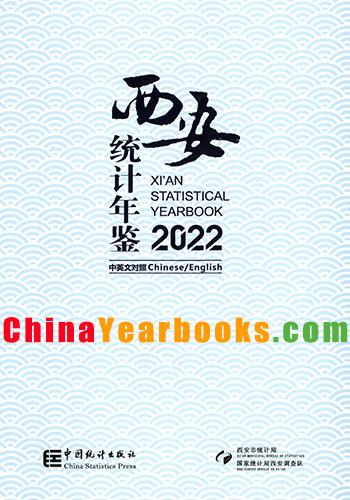
Xian Statistical Yearbook 2022

Xi’an Statistical Yearbook 2022 Download

Yearbook title:西安统计年鉴2022
Yearbook English title:Xi’an Statistical Yearbook 2022
Published Date :2022.09
ISBN:978-7-5037-9905-1
Language : English and Chinese bilingual
Availability : Printed Version;Electronic Version(PDF Version)

Xian Statistical Yearbook 2022

Ⅰ.Xi’an Statistical Yearbook 2022 is a periodical statistic yearbook that records the economic and social development of Xi’an all-around in 2021 and some selected data series in important historical years.With its features of comprehensive and intensive information,this book provides data covering the situation of social and economic developments in Xi’an. Ⅱ.The book contains twenty-two parts,1.General Survey;2.Basic Unit;3.National Economic Account;4.Population、Employment and Wages;5.Investment in Fixed Assets;6.Government Finance;7.Price Indices;8.People’s Livelihood;9.Urban Public Utilities;10.Environmental Protection;11.Agriculture;12.Industry;13.Energy;14.Construction;15.Transportation、Post and Informatization;16.Domestic Trade;17.Foreign Trade;18.Service Industry;19.Financial Intermediation;20.Education、Science and Technology;21.Culture、Sports、Public Health、Social Welfare and Other Social Activities;22.Enterprises Investigation.Meanwhile,for the reader’s convenience,a brief explanation and major statistical indicators are provided before each chapter,and the main contents、sources and historical changes of this chapter are briely summarized.The end of part is accompanied by the interpretation of major statistical indicators. Ⅲ.The data of various years in conformity with to the statistical standards prescribed by the national statistical system of the time.The meaning、scope and calculating method of indicators may have some differences in different periods,which readers must pay attention.For example,national industries classification is carried out according to standard GB/T4754-2017. Ⅳ For the convenience of being consulted by foreigners,the book is a Chinese-English bilingual edition. Ⅴ.In this yearbook,the data on national economy accounting in 2018 is the Fourth National Economic Census data,and the data from 2003 to 2017 are the revised data of the Fourth Economic Census.The 2018 data of the industrial part is the Fourth Economic Census data.The domestic trade data from 1993 to 2017 is revised from the Fourth Economic Census.The total output value and output of agriculture、forestry、animal husbandry and fishery from 2007 to 2017 and the livestock products from 2013 to 2017 are adjusted data of the Third Agricultural General Census.The data on permanent population and related indicators from 2011 to 2019 is revised from the Seventh National Population Census;The data on fixed asset investment are mainly relative indicators such as growth rate.Science and technology data(except department data) and innovation activities were data in 2020. Ⅵ.Statistical scope:Data of 2021 in this yearbook,the basic unit、national economic accounting、agriculture、industry、construction industry、domestic trade、services、energy、investment in fixed assets、permanent resident population、labor and wages、informatization、enterprise survey、water resources does not include Xixian New District.Household registered population、land area are Xi’an original caliber data.The scope of other data is the description of each part or notes under the table. Ⅶ.Statistical discrepancies due to rounding are not adjusted automatically in this yearbook. Ⅷ.Unit of measurement is used in this yearbook according to the 2021 statistics system. Ⅸ.Explanations of symbols used in this yearbook: “…” indicates the data is less than the minimum unit in this table; (Blank) shows the data is not available; #shows the one of items; *indicates some other explanatory note. Here we would like to express our sincere thanks to the people for their concern and support of the Xi’an statistical yearbook.To do better and provide better service to readers,we hope that the whole of society fields can propose constructive advice.

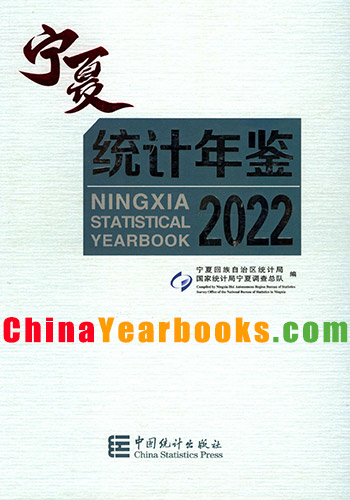
Ningxia Statistical Yearbook 2022

Ningxia Statistical Yearbook 2022 Download

Yearbook title:宁夏统计年鉴2022
Yearbook English title:Ningxia Statistical Yearbook 2022
Published Date :2022.11
ISBN:978-7-5230-0008-3
Language : English and Chinese bilingual
Availability : Printed Version;Electronic Version(PDF Version)

Ningxia Statistical Yearbook 2022

Ⅰ.Ningxia Statistical Yearbook 2022 is a comprehensive,systematic and objective information yearbook re-flecting the economic and social development of Ningxia,which is jointly prepared by the Statistics Bureau ofNingxia Hui Autonomous Region and the Ningxia investigation team of the National Bureau of statistics and pub-lished by China Statistics Press.It is an indispensable tool for studying the situation of Ningxia,exchanging socialinformation,formulating policies and guiding work.It is also an important window for all circles at home andabroad to understand Ningxia.This yearbook contains the statistical data of economic and social aspects of Ningxiain important historical years and 2021,the main statistical data of cities and counties(districts),as well as themain statistical data of the whole country and provinces(cities and districts). Ⅱ.The yearbook contains twenty-three chapters:1.Administrative Divisions and Natural Resources;2.GeneralSurvey;3.National Accounts;4.Population;5.Employment and Wages;6.Investment in Fixed Assets;7.Energy;8.Government Finance,Financial Intermediation and Insurance;9.Prices Indices;10.People’s Living Conditions;11.Agriculture;12.Industry;13.Construction;14.Transport,Postal and Telecommunication Services;15.Wholesale,Retail,Housing and Catering;16.Foreign Trade Economic Cooperation and Tourism;17.Education,Scienceand Technology Culture;18.Sports,Public Health,Civil Administration and Judicature;19.Ecological Environment;20.Main Survey Information of Service Enterprise above Designated Size;21.Enterprise Information and ElectronicCommerce;22.Economic and Social development of Agricultural Cultivation in Ningxia;23.Main Economic Indicatorsby Region. To facilitate readers,some chapters are accompanied by explanatory Notes on Main Statistical Indicators. Ⅲ.Most of the statistical data in this yearbook come from the statistical annual report,and some come fromthe sample survey,main economic indicators by Region are from China Statistical Yearbook 2022 and China Statisti-cal Abstract of that year.The data in this book refer to 2021,with the exception of the year specified. Ⅳ.For updated historical data,please refer to the newly published version of the yearbook.Statistical dis-crepancies on totals and relative figures due to rounding are not adjusted in the yearbook. Ⅴ.Compared with the Ningxia Statistical Yearbook 2021,according to the revision of the current statisticalsurvey system,there are the following changes:the final consumption,total capital formation,total investment infixed assets of the whole society,GDP calculated by the expenditure method,the area of houses constructed by thewhole society,the floor area of houses completed by the whole society,the price index of agricultural means of pro-duction,fixed asset investment price index,cultivated land area,total post and telecommunications business,ur-ban per capita building area,rural per capita living area,birth rate,natural population growth rate and other indi-cator data were cancelled. Ⅵ.Thanks for the support in the publication and distribution of this yearbook.We sincerely hope that readersfrom all walks of life will give us your valuable comments with a view to further improving and enhancing our work.

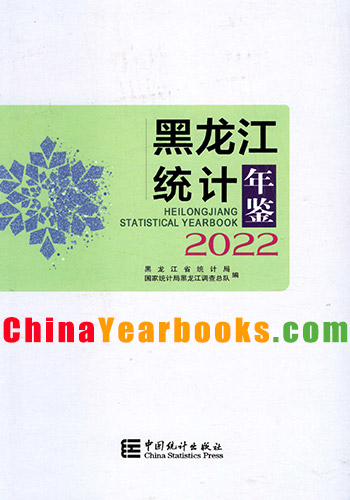
Heilongjiang Statistical Yearbook 2022

Heilongjiang Statistical Yearbook 2022 Download

Yearbook title:黑龙江统计年鉴2022
Yearbook English title:Heilongjiang Statistical Yearbook 2022
Published Date :2022.12
ISBN:978-7-5230-0027-4
Language : English and Chinese bilingual
Availability : Printed Version;Electronic Version(PDF Version)

Heilongjiang Statistical Yearbook 2022

Ⅰ.Heilongjiang Statistical Yearbook—2022 is an annual statistics publication,which covers very comprehensive data in 2021 and some selected data series in historically important years at provincial levels and local levels of cities,regions,and counties directly under the provincial government and therefore,reflects various aspects of social and economic development of Heilongjiang. Ⅱ.The book contains the following 20 parts,1.General Survey;2.Population,Employment and Wages;3.National Accounts;4.Price Indices;5.People’s Living Conditions;6.Government Finance,Financial Intermediation and Insurance;7.Resources and Environment;8.Energy;9.Investment in Fixed Assets;10.Foreign Trade and Economic Cooperation;11.Agriculture;12.Industry;13.Construction;14.Housing and Real Estate;15.Domestic Trade and Tourism;16.Transport,Postal and Telecommunication Services;17.Education,Science and Technology;18.Culture,Sports,Public Health and Social Services;19.General Survey of Cities;APPENDIX.Main Indicators of Counties(2021).In addition,explanatory notes on main statistical indicators are provided at the end of each part. Ⅲ.The units of measurement used in this book are internationally standard measurement units. Ⅳ.The major data sources of this publication are obtained from annual statistical reports,and some from sample surveys and professional departments.Statistical coverage of some professionalhistorical data has adjusted.Please attention to explanatory notes in charts. Ⅴ.Some statistical data gathering from regions are not the same as total of province.Please attention to use.Statistical discrepancies due to rounding are not adjusted in this yearbook. Ⅵ.Economic indicators in appendix are statistical data of county.The data are not checked from level.It is reference only. Ⅶ.Notations used in this yearbook: “(Blank)” indicates that the data are unknown or are not available or the figure is not large enough to be measured with the smallest unit in the table;”#” indicates the major items of the total.

Hangzhou Statistical Yearbook 2022

Hangzhou Statistical Yearbook 2022 Download

Yearbook title:杭州统计年鉴2022
Yearbook English title:Hangzhou Statistical Yearbook 2022
Published Date :10/2022
ISBN:978-7-5037-9933-4
Language : English and Chinese bilingual
Availability : Printed Version;Electronic Version(PDF Version)

Hangzhou Statistical Yearbook 2022

Ⅰ.Hangzhou Statistical Yearbook 2022 is an informative annual which contains very comprehensive statistics of Hangzhou’s social and economic development in 2021,and selected data of recent years and some historically important years. Ⅱ.This yearbook is composed of 13 chapters:1.General Survey;2.Population and Employment;3.Agriculture;4.Industry and Energy;5.Construction;6.Transportation,Post and Telecommunications;7.Investment in Fixed Assets;8.Wholesale and Retail Trade and Hotel and Catering Trade;9.Foreign Economic Cooperation and Tourism;10.Finance,Banking and Insurance;11.Urban Construction and Environmental Protection;12.Science and Technology,Education,Culture,Public Health and Sports;13.People’s Livelihood,Price Indices and Civil Administration.To facilitate readers,each chaper provides brief introduction and explanatory notes on main statistical indicators. Ⅲ.Please refer to the newly published version of the yearbook for updated historical data.Statistical discrepancies on totals and relative figures due to rounding are not adjusted in the yearbook. Ⅳ.Because of the change of urban administrative division,the data of Xiaoshan District and Yuhang District have been included into the urban districts since 2001,and it is the same for Fuyang District since 2014,Lin’an District since 2017.Qiantang New Area has been added into classification of districts and counties since 2019.Figures of Xiaoshan District without special explanation all include districts under administered by Qiantang New Area.Since 2021,the original Shangcheng,Xiacheng,Jianggan,Gongshu and Yuhang have been abolished,and the new Shangcheng,Gongshu,Yuhang,Linping and Qiantang have been established. Ⅴ.Notations used in this yearbook:”—” indicates that the column has no figure;”…” indicates that the figure is not large enough to be measured with the smallest unit in the table;”#” indicates the major items of the total;”blank” indicates that the data are unknown or unavailable;”*” indicates”see footnotes below”. Ⅵ.International standard units of measurement are applied in this yearbook,all amounts are denominated in RMB,unless otherwise indicated. Ⅶ.Since published openly,we are so grateful that the previous editions of Hangzhou Statistical Yearbook have been widely concerned and supported.In order to get further improvement in the yearbook editing,we welcome all candid comments and criticism from our readers.

Xian Statistical Yearbook 2021

Xi’an Statistical Yearbook 2021 Download

Yearbook title:西安统计年鉴2021
Yearbook English title:Xi’an Statistical Yearbook 2021
Published Date :09/2021
ISBN:978-7-5037-9561-9
Language : English and Chinese bilingual
Availability : Printed Version;Electronic Version(PDF Version)

Xi'an Statistical Yearbook 2021
Xi’an Statistical Yearbook 2021

Ⅰ.Xi’an Statistical Yearbook 2021 is a periodical statistic yearbook which record economic and social development of Xi’an all-around in 2020 and some selected data series in historical important years.With its features of comprehensive andintensive information,this practically provides data covering the situation of social and economic developments in Xi’an. Ⅱ.The book contains twenty-two parts,1.General Survey;2.Basic Unit;3.National Economic Account;4.Population,Employment and Wages;5.Investment in Fixed Assets;6.Government Finance;7.Price Indices;8.People’s Livelihood;9.Urban Public Utilities;10.Environmental Protection;11.Agriculture;12.Industry;13.Energy;14.Construction;15.Transportation,Post and Informatization;16.Domestic Trade;17.Foreign Trade;18.Service Industry;19.FinancialIntermediation;20.Education,Science and Technology;21.Culture,Sports,Public Health,Social Welfare and Other SocialActivities;22.Enterprises Investigation.Meanwhile,for the convenience of the reader,a brief explanation and major statistical indicators are provided before each chapter,the main contents,sources and historical changes of this chapter are briefly summarized.The final part is accompanied by the interpretation of major statistical indicators.Ⅲ.The data of various years in conformity to the statistical standards prescribed by national statistical system of the time.The meaning,scope and calculating method of indicators may have some difference in different periods,which readers must pay attention to For example,national industries classification is carried out according to standard GB/T4754-2017. Ⅳ.For the convenience of being consulted by foreigners,the book is Chinese-English bilingual edition. Ⅴ.In this yearbook,the data of 2018 at the part of National Economic Accounting and Industry is the results of Fourth National Economic Census,the data from 2003 to 2017 at the part of National Economic Account have adjusted by Fourth National Economic Census.The data of industry in 2018 is revised for The Fourth National Economic Census;Thedomestic trade part of 1993 to 2017 is based on the adjusted data of The Fourth National Economic Census.The agricultural output,the total output value,output of agriculture,forestry,animal husbandry and fishery in 2007 to 2017 and the livestock products and aquatic products in 2013 to 2017 are based on the adjusted data of the third agricultural census.The data of permanent population and related indicators from 2011 to 2019 are the revised data of the seventh national population census.The per capita disposable income of urban residents and rural residents is revised based on the new caliber innovation activities in 2019;Fixed asset investment data are mainly relative indicator data such as growth rate. Ⅵ.Statistical scope:in this yearbook,the data from 2017 about the basic unit,the national economic accounting,agriculture,industry,construction industry,domestic trade,services,energy,investment in fixed assets,labor wages,informatization,enterprise survey,urban public utilities,finance,education,culture,health and social welfare contains Xixian New District.Since 2018,the indicators such as people’s living and utilization of foreign capital include XixianNew District.Since 2019,the indicators such as securities and meteorology include Xixian New District.Since 2020,theindicatiors such as water resources are include Xixian New District.The price index(except for individual indicators),transportation,post and telecommunications,environmental protection,foreign trade and tourism(except for someindicators),Banking and Insurance,sports,household registration,land area and other indicators are Xi’an originalcaliber data or does not include Xixian New District.See the notes under the table for details. Ⅶ.Statistical discrepancies due to rounding are not adjusted automatically in this yearbook. Ⅷ.Unit of measurement is used in this yearbook according to 2020 statistics system. Ⅸ.Explanations on symbols used in this yearbook: “…” indicates the data is less than the minimum unit in this table; (Blank) indicates the data not available; #indicates the items of the total; *indicates some other explanatory note. Here we would like to express our sincere thanks to the people for their concerning and support to the Xi’an statistical yearbook.In order to do better and provide better service to readers,we hope that the whole society fields can propose constructive advices.

Guangzhou Statistical Yearbook 2022

Guangzhou Statistical Yearbook 2022 Download

Yearbook title:广州统计年鉴2022
Yearbook English title:Guangzhou Statistical Yearbook 2022
Published Date :10/2022
ISBN:978-7-5230-0000-7
Language : English and Chinese bilingual
Availability : Printed Version;Electronic Version(PDF Version)

Guangzhou Statistical Yearbook 2022

Ⅰ.Guangzhou Statistical Yearbook 2022 is a reference book that comprehensively reflects the economic and social development of Guangzhou.Through a large number of statistical data,this book comprehensively and objectively records the economic and social development of Guangzhou in 2021 and important historical years. Ⅱ.The Yearbook contains the following 18 chapters:1.General Survey;2.Population;3.Employment and Wages;4.Investment in Fixed Assets;5.Energy and Environment;6.Government Finance and Banking;7.Price Indices;8.People’s Livelihood;9.City Construction;10.Agriculture;11.Industry;12.Construction;13.Transport,Postal and Telecommunication Services;14.Domestic Trade;15.Foreign Economy and Tourism;16.Service Industry above Scale;17.Science and Technology;18.Education,Culture,Sports,Public Health,Social Welfare and Others.In the Appendix,the main economic indicators of China,Guangdong Province,Hong Kong Special Administrative Region,Macao Special Administrative Region and the Guangdong-Hong Kong-Macao Greater Bay Area are collected. Ⅲ.The data in the Yearbook are mainly obtained from various statistical statements and sampling surveys conducted by Statistics Bureaus of all levels of government and the Survey Office of the National Bureau of Statistics in Guangzhou.Some data are collected from the departments of the provincial and municipal government. Ⅳ.Since 2014 Guangzhou administrative division has been adjusted.The original Huangpu and Luogang districts have been merged into the new Huangpu district.The former Zengcheng City and the former Conghua City are divided into districts.Since 2015,Guangzhou city administrative division has included 11 districts,which are Liwan district,Yuexiu district,Haizhu district,Tianhe district,Baiyun district,Huangpu district,Panyu district,Huadu district,Nansha district,Conghua district and Zengcheng district,excluding county-level cities. Ⅴ.Urban and rural integrated household survey is carried out in Guangzhou from 2014,statistical indicator system of urban and rural integrated household survey is changed greatly. Ⅵ.According to The Notice of the National Bureau of Statistics on the Implementation of the New National Standard of National Economic Industry Classification(Guotongzi [2017] No.142),the new classification of National Economic Sectors GB/T4754-2017 has been used from the statistical annual statements of 2017 and the periodic statistical statements of 2018. Ⅶ.Starting from 2018,a new chapter entitled “Service Industry above scale” has been added. Ⅷ.The prices used in calculation in the Yearbook are current prices except noted. Ⅸ.In any case the data of this book shall be deemed as the authoritative ones. Ⅹ.In the Yearbook all calculating errors of some total and regular figures for the difference of measuring units haven’t been adjusted. Ⅺ.Notations in this book:blank space indicates data are not available.”…” indicates not large enough to be rounded into the least unit of measurement.”#” indicates major item in a category. Ⅻ.In 2019,according to the results of the fourth national economic census,the regional GDP from 2008 to 2018,the industry from 2010 to 2017,the entire society’s employees at the end of the year from 2011 to 2018,and the total retail sales of consumer goods from 1992 to 2018 were revised. ⅩⅢ.In 2020,according to the results of the Seventh National Census,the permanent population and the proportion of permanent urban population from 2011 to 2019 were revised.