China Statistical Yearbook 2025 Download
Yearbook title:中国统计年鉴2025
Yearbook English title:China Statistical Yearbook 2025
In the process of publication, please wait
Central Government Level
China Statistical Yearbook 2025 Download
Yearbook title:中国统计年鉴2025
Yearbook English title:China Statistical Yearbook 2025
In the process of publication, please wait
China Statistical Yearbook 2024 Download
Yearbook title:中国统计年鉴2024
Yearbook English title:China Statistical Yearbook 2024
Published Date :2024.09
ISBN:978-7-5230-0486-9
Language : English and Chinese bilingual
Availability : Printed Version;Electronic Version(PDF Version)

1、 The “China Statistical Yearbook 2024” system collects economic and social data from various provinces, autonomous regions, and municipalities directly under the central government in 2023, as well as important historical years and major statistical data from recent years. It is an informative annual publication that comprehensively reflects the economic and social development of the People’s Republic of China. 2、 The main content of this yearbook is divided into 28 chapters, namely: 1. Comprehensive; 2. Population; 3. National economic accounting; 4. Employment and wages; 5. Price; 6. People’s livelihood; 7. Finance; 8. Resources and environment; 9. Energy; 10. fixed assets investment; 11. Foreign economic and trade relations; 12. Agriculture; 13. Industry; 14. Construction industry; 15. Wholesale and retail industry; 16. Transportation, postal and telecommunications, and software industries; 17. Accommodation, catering, and tourism; 18. Financial industry; 19. Real estate; 20. Science and technology; 21. Education; 22. Health and social services; 23. Culture and sports; 24. Public administration, social security, and social organizations; 25. Urban, rural, and regional development; 26. Major socio-economic indicators of the Hong Kong Special Administrative Region; 27. Main socio-economic indicators of the Macao Special Administrative Region; 28. Major socio-economic indicators of Taiwan Province; And in the appendix section, major international socio-economic indicators. For the convenience of readers, brief explanations are provided before each chapter, providing a brief overview of the main content, sources of information, statistical scope, statistical methods, and historical changes of this chapter. The main statistical indicators are explained at the end of the article. 3、 The national statistical data involved in this yearbook, except for administrative divisions, forest resources, and special notes, do not include data from Hong Kong, Macao Special Administrative Region, and Taiwan Province. According to the relevant principles of the Basic Law of the Hong Kong Special Administrative Region and the Basic Law of the Macao Special Administrative Region of the People’s Republic of China, Hong Kong, Macao, and the mainland are relatively independent statistical regions. According to their respective statistical systems and legal provisions, they independently conduct statistical work. The relevant statistical data in this yearbook are provided by the Hong Kong Special Administrative Region Government Statistics Department and the Macao Special Administrative Region Government Statistics and Census Bureau, respectively, and edited by the National Bureau of Statistics. 4、 The specific division of the eastern, central, western, and northeastern regions covered by this yearbook is as follows: Eastern region: there are 10 provinces (municipalities directly under the central government), including Beijing, Tianjin, Hebei, Shanghai, Jiangsu, Zhejiang, Fujian, Shandong, Guangdong, and Hainan. Central region: There are 6 provinces, including Shanxi, Anhui, Jiangxi, Henan, Hubei, and Hunan. Western China: There are 12 provinces (autonomous regions and municipalities directly under the Central Government), including Inner Mongolia, Guangxi, Chongqing, Sichuan, Guizhou, Yunnan, Xizang, Shaanxi, Gansu, Qinghai, Ningxia and Xinjiang. Northeast region: There are three provinces, including Liaoning, Jilin, and Heilongjiang. 5、 The units of measurement used in this yearbook are internationally standardized units of measurement, and the latest product catalog issued and implemented is uniformly used. 6、 The historical data mentioned in this yearbook shall be based on the latest published data in this yearbook; The calculation errors caused by different unit choices in the total or relative numbers of some data in this yearbook have not been mechanically adjusted. 7、 Symbol usage instructions: The “space” in each table of the yearbook indicates that the statistical indicator data is unknown or unavailable; # “represents the main item; “” “or” ① “” indicates that there are annotations under this table. The specific usage of symbols in Hong Kong and Macau can be found in their respective chapter descriptions. 8、 Compared with the “China Statistical Yearbook 2023”, this yearbook has made the following revisions based on the current statistical survey system and statistical work: in order to meet the needs of economic classification in statistical surveys, the National Bureau of Statistics, in conjunction with the State Administration for Market Regulation, has revised the “Provisions on the Classification of Enterprise Registration Types” (Guotongzi [2011] No. 86) (hereinafter referred to as the “original standard”) and jointly issued the “Provisions on the Classification of Market Entities Statistics” (Guotongzi [2023] No. 14) (hereinafter referred to as the “new standard”). This yearbook has made corresponding adjustments to relevant groups according to the “new standard”. The original standard for revision work was jointly formulated and issued by the National Bureau of Statistics and the former State Administration for Industry and Commerce in 1998, and was revised in 2011. Since its implementation, this standard has provided important support for conducting statistical surveys, statistical analysis, and market supervision. In recent years, new laws and regulations such as the Foreign Investment Law of the People’s Republic of China and the Regulations on the Administration of Market Entity Registration of the People’s Republic of China have been successively introduced and implemented. The original Regulations on the Administration of Company Registration of the People’s Republic of China, the Regulations on the Administration of Enterprise Legal Person Registration of the People’s Republic of China, and the Interim Regulations on Private Enterprises of the People’s Republic of China have been abolished, and significant changes have occurred in the relevant laws and regulations on which the original standards were based. In order to adapt to the new changes in the registration and management scope of the market supervision department from “enterprises” to “market entities”, and to ensure that statistical work is carried out in accordance with laws and regulations, the National Bureau of Statistics, together with the State Administration for Market Regulation, will carry out the revision of this standard from 2022. Based on extensive solicitation of opinions and suggestions from various professions, localities, and relevant departments, the “Regulations on the Classification of Market Entity Statistics” (the “new standard”) will be jointly issued in January 2023. 2. Revised main content: (1) Expanding the scope of application: In order to comprehensively cover the statistical survey objects, the new standard adjusts the classification scope according to the actual registration and management of market entities, expanding from “enterprises” to all “market entities”, and adding categories such as “farmer professional cooperatives (cooperatives)” and “individual industrial and commercial households”. (2) Due to the abolition of the Provisional Regulations of the People’s Republic of China on Private Enterprises, the relevant categories of “private limited liability companies” and “private joint stock limited companies” have been included in the scope of “limited liability companies” and “joint stock limited companies” respectively, according to the Company Law of the People’s Republic of China, the Law of the People’s Republic of China on Individual Proprietorship Enterprises, and the Law of the People’s Republic of China on Cooperative Enterprises. “Private sole proprietorship enterprises” have been adjusted to “individual sole proprietorship enterprises”, and “private partnership enterprises” have been adjusted to “partnership enterprises”. (3) Adjusting the classification structure is related to “domestic enterprises”. According to the Regulations on the Administration of Market Entity Registration of the People’s Republic of China, the original classification of domestic enterprises, including “state-owned enterprises”, “collective enterprises”, “joint-stock cooperative enterprises”, “joint ventures”, “limited liability companies”, “joint-stock limited companies”, “private enterprises”, and “other enterprises”, has been adjusted to six categories, including “limited liability companies”, “joint-stock limited companies”, “non corporate legal persons”, “sole proprietorships”, “partnerships”, and “other domestic enterprises”. Among them, the original “state-owned enterprises,” “collective enterprises,” “joint-stock cooperative enterprises,” and “joint venture enterprises” are included in the new category of “non corporate legal persons; The original category of “private enterprises” has been cancelled (as mentioned in the previous paragraph). The second is about “foreign-invested enterprises” and “Hong Kong, Macao, and Taiwan investment enterprises”. According to the Foreign Investment Law of the People’s Republic of China, the original five categories of foreign-invested enterprises, including “Sino foreign joint ventures,” “Sino foreign cooperative enterprises,” “foreign-funded enterprises,” “foreign-invested joint stock limited companies,” and “other foreign-invested enterprises,” have been adjusted to four categories, including “foreign-invested limited liability companies,” “foreign-invested joint stock limited companies,” “foreign-invested partnership enterprises,” and “other foreign-invested enterprises. Hong Kong, Macao, and Taiwan investment enterprises are adjusted according to the classification method for foreign-invested enterprises. (4) According to the standardized names for registration management by the market supervision department, the original “state-owned enterprises” and “collective enterprises” will be renamed as “state-owned enterprises” and “collective owned enterprises” respectively. (5) According to the Foreign Investment Law of the People’s Republic of China and relevant departmental regulations, the scope of unified domestic investment includes market entities such as limited liability companies registered as domestic companies (invested by foreign-invested enterprises) and joint-stock limited companies registered as domestic companies (listed, invested by foreign-invested enterprises), which are the reinvestment market entities of foreign-invested enterprises in China. The category of “foreign-invested enterprises” in the original standard has been adjusted to the relevant category of “domestic enterprises” in the new standard. In addition, in the “Resources and Environment” section, add “Number of collapsed houses”. In the “agriculture” part, increase the planting area of “soybean”, “peanut”, “rapeseed”, “sesame”, “sugarcane”, “sugar beet” and “flue-cured tobacco” and the output value and index of “agriculture, forestry, animal husbandry, fishery and professional and auxiliary activities”. In the “industrial” section, increase the production of “smartphones”. In the “Health and Social Services” section, add two tables: “Regional Child Health Status” and “Regional Maternal Health Status”. In the “Culture and Sports” section, increase the number of children’s literature in public libraries and the number of underage visitors to state-owned museums. In the “Urban, Rural, and Regional Development” section, add information on “Rural hydropower stations”, “Rural hydropower installed capacity”, and “Rural hydropower annual power generation”.
China Statistical Yearbook 2023 Download
Yearbook title:中国统计年鉴20223
Yearbook English title:China Statistical Yearbook 2023
Published Date :2023.09
ISBN:978-7-5230-0190-5
Language : English and Chinese bilingual
Availability : Printed Version;Electronic Version(PDF Version)
Ⅰ. China Statistical Yearbook 3023 is an annual statistical publication, which reflects comprehensively the economic and social development of China. It covers data for 2022 and key statistical data in recent years and some historically important years at the national level and the local levels of province, autonomous region and municipality directly under the Central Government.
Ⅱ. The Yearbook contains twenty-eight chapters: 1. General Survey; 2. Population; 3. National Accounts; 4. Employment and Wages; 5. Prices; 6. People’s Livelihoods; 7. Government Finance; 8. Resources and Environment; 9. Energ;10. Investment in Fixed Assets; 11. International Trade and Economic Cooperation; 12. Agriculture; 13. Industry; 14. Construction; 15. Wholesale and
Retail Trades; 16厂Transport. Postal and Telecommunication Services, and Software Industry; 17. Hotels, Catering Services and Tourism; 18. Financial Intermediation; l9. Real Estate; 20. Science and Technology; 21. Education; 22. Public Health and Social Services; 23. Culture and Sports; 24. Public Management, Social Security and Social Organizations; 25. Urban, Rural and Regional
Development; 26. Main Social and Economic Indicators of Hong Kong Special Administrative Region; 27. Main Social and Economic Indicators of Macao Special Administrative Region; 28. Main Social and Economic Indicators of Taiwan Province. One chapter listed as Appendix is Main Social and Economic Indicators of Other Countries/Regions.
To facilitate readers, the Brief Introduction at the beginning of each chapter provides a summary of the main contents of the chapter, data sources, statistical coverage, statistical methods and historical changes. At the end of each chapter, Explanatory Notes on Main Statistical Indicators are included.
Ⅲ. The national data in this book do not include those of the Hong Kong Special Administrative Region, the Macao Special Administrative Region and Taiwan Province, except for the divisions of administrative areas, forest resources and otherwise specified.
In accordance with the principles set down in the Basic Law of Hong Kong Special Administrative Region, and the Basic Law of Macao Special Administrative Region;statistically Hong Kong, Macao and the mainland of China are three mutually independent
regions. each following its own and different statistical systems and legal provisions in conducting statistical operation independently.
Statistics on the Hong Kong Special Administrative Region and the Macao Special Administrative Region as included in this
yearbook are provided by the Census and Statistics Department of the Government of Hong Kong Special Administrative Region and
the Statistics and Census Service of the Government of Macao Special Administrative Region respectively; and are edited by the
National Bureau of Statistics.
Ⅳ Eastern region, central region, western region and northeastern region in the Yearbook are divided as following:
Eastern region with 10 provinces (municipalities) includes: Beijing, Tianjin, Hebei, Shanghai, Jiangsu, Zhejiang, Fujian,Shandong, Guangdong and Hainan;
Central region with 6 provinces includes: Shanxi, Anhui, Jiangxi, Henan, Hubei and Hunan;
Western region with 12 provinces (autonomous regions and municipalities) includes: Inner Mongolia, Guangxi, Chongqing,Sichuan. Guizhou. Yunnan, Tibet, Shaanxi, Gansu. Qinghai. Ningxia and Xinjiang;
Northeastern region with 3 provinces includes: Liaoning, Jilin and Heilongjiang.
Ⅴ The units of measurement used in the Yearbook are international standard measurement units, and newly published and implemented Product Categories are uniformly used.
Ⅵ. For updated historical data, please refer to the newly published version of the Yearbook. Statistical discrepancies on totals and relative figures due to rounding are not adjusted in the Yearbook.
Ⅶ. Notations used in the Yearbook: (blank space) indicates that the data are unknown, or are not available;”#”indicates a major breakdown of the total; and”*”or”①”indicates footnotes at the end of the table. For notations in the chapters of data on
Hong Kong SAR and Macao SAR, please refer to the brief introduction or explanation in the relevant chapters.
Ⅷ. In comparison with China Statistical Yearbook 202?, following revisions have been made in this new version in terms of the statistical contents and in editing. In the chapter on “General Survey”, the meaning of number of divisions at township level is changed. In the chapter on “Resources and Environment”,the indicator “major marine disasters” increase the data of damaged
seawall and revetment. In the chapter on “Industry”, the economic benefits of private industrial enterprises in the “other mining industry” industry, foreign investment in the “tobacco product industry” and industrial enterprises invested by Hong Kong, Macao,and Taiwan businessmen have been added. In the chapter on “Science and Technology”, the indicator of R&D and related activities of high-tech industry (manufacturing) enterprises is added. In the chapter on “Education”, the indicator of vocational undergraduates by region is added. In the chapter on “Science and Technology”, the indicator of R&D and related activities of high-tech industry (manufacturing) enterprises is added. In the chapter on “Public Health and Social Services”, the indicator of vocational undergraduates by region is added. the meaning of patients discharged per bed, inpatients per 100 outpatient and emergency visits and per capita health expendiRire are changed. In the chapter on “Public Management, Social Security and Social Organizations”, the indicator of cases of endangering public safety, disrupting the order of the socialist market economy, infringing on citizens’ personal and democratic rights. infringing on property, disrupting social management order, and other types of criminal protest cases handled by People’s Procuratorate by region are added. The indicator of expenses of birth insurance is added. The meaning of retired personnel is changed.
China Statistical Yearbook 2022 Download
Yearbook title:中国统计年鉴2022
Yearbook English title:China Statistical Yearbook 2022
Published Date :09/2022
ISBN:978-7-5037-9950-1
Language : English and Chinese bilingual
Availability : Printed Version;Electronic Version(PDF Version)
Ⅰ.China Statistical Yearbook 2022 is an annual statistical publication,which reflects comprehensively the economic and social development of China.It covers data for 2021 and key statistical data in recent years and some historically important years at the national level and the local levels of province,autonomous region and municipality directly under the Central Government. Ⅱ.The Yearbook contains twenty-eight chapters:1.General Survey;2.Population;3.National Accounts;4.Employment and Wages;5.Prices;6.People’s Livelihoods;7.Government Finance;8.Resources and Environment;9.Energy;10.Investment in Fixed Assets;11.International Trade and Economic Cooperation;12.Agriculture:13.Industry;14.Construction;15.Wholesale and Retail Trades;16.Transport,Postal and Telecommunication Services,and Software Industry;17.Hotels,Catering Services and Tourism;18.Financial Intermediation;19.Real Estate;20.Science and Technology;21.Education;22.Public Health and Social Services;23.Culture and Sports;24.Public Management,Social Security and Social Organizations;25.Urban,Rural and Regional Development;26.Main Social and Economic Indicators of Hong Kong Special Administrative Region;27.Main Social and Economic Indicators of Macao Special Administrative Region;28.Main Social and Economic Indicators of Taiwan Province.One chapter listed as Appendix is Main Social and Economic Indicators of Other Countries/Regions. To facilitate readers,the Brief Introduction at the beginning of each chapter provides a summary of the main contents of the chapter,data sources,statistical coverage,statistical methods and historical changes.At the end of each chapter,Explanatory Notes on Main Statistical Indicators are included. Ⅲ.The national data in this book do not include those of the Hong Kong Special Administrative Region,the Macao Special Administrative Region and Taiwan Province,except for the divisions of administrative areas,forest resources and otherwise specified.In accordance with the principles set down in the Basic Law of Hong Kong Special Administrative Region,and the Basic Law of Macao Special Administrative Region,statistically Hong Kong,Macao and the mainland of China are three mutually independent regions,each following its own and different statistical systems and legal provisions in conducting statistical operation independently.Statistics on the Hong Kong Special Administrative Region and the Macao Special Administrative Region as included in this yearbook are provided by the Census and Statistics Department of the Government of Hong Kong Special Administrative Region and the Statistics and Census Service of the Government of Macao Special Administrative Region respectively;and are edited by the National Bureau of Statistics. Ⅳ.Eastern region,central region,western region and northeastern region in the Yearbook are divided as following: Eastern region with 10 provinces(municipalities) includes:Beijing,Tianjin,Hebei,Shanghai,Jiangsu,Zhejiang,Fujian,Shandong,Guangdong and Hainan; Central region with 6 provinces includes:Shanxi,Anhui,Jiangxi,Henan,Hubei and Hunan; Western region with 12 provinces(autonomous regions and municipalities) includes:Inner Mongolia,Guangxi,Chongqing,Sichuan,Guizhou,Yunnan,Tibet,Shaanxi,Gansu,Qinghai,Ningxia and Xinjiang; Northeastern region with 3 provinces includes:Liaoning,Jilin and Heilongjiang. Ⅴ.The units of measurement used in the Yearbook are international standard measurement units,and newly published and implemented Product Categories are uniformly used. Ⅵ.For updated historical data,please refer to the newly published version of the Yearbook.Statistical discrepancies on totals and relative figures due to rounding are not adjusted in the Yearbook. Ⅶ.Notations used in the Yearbook:(blank space) indicates that the data are unknown,or are not available;“#”indicates a major breakdown of the total;and “*”or“①”indicates footnotes at the end of the table.For notations in the chapters of data on Hong Kong SAR and Macao SAR,please refer to the brief introduction or explanation in the relevant chapters. Ⅷ.In comparison with China Statistical Yearbook 2021,following revisions have been made in this new version in terms of the statistical contents and in editing.In the chapter on “National Accounts”,input-output tables of intermediate use part,final use part and 17×17 product department are added.In the chapter on “People’s Livelihoods”,the per capita disposable income of rural households in the poverty relief counties of 22 provinces equivalent administrative units in central and western China are added.In the chapter on “Agriculture”,relevant indicators of “grain,soybean,sugar” have been added.In the chapter on “Transportation,Postal and Telecommunication Services and Software Industry”,the indicator “3G mobile phone subscribers” is revised to “5G mobile phone subscribers”.In the chapter on “Financial Intermediation”,increase the loan prime rate(LPR),relevant index data of Beijing Markets and bonds data in the interbank market.In the chapter on “Education”,the indicators of “consolidation rate of nine-year compulsory education”,”gross enrollment rate of high school education ” and “gross enrollment rate of higher education” are added,and the indicators of “regular higher education institutions”,”undergraduate in regular HEls “,”social donation funds”,”tuition and miscellaneous fees” are revised into ” regular and vocational higher education”,” regular and vocational colleges and universities”,”donation income” and “tuition” respectively.In the chapter on “Public Health and Social Services”,the indicators “number of inpatients “,”number of patients discharged” and “personal cash health expenditure” are modified to “inpatients”,”number of patients discharged” and “personal health expenditure” respectively.In the chapter on “Urban,Rural and Regional Development”,the data of the Yangtze River Delta has been added.
China Statistical Yearbook 2021 Download
Yearbook title:中国统计年鉴2021
Yearbook English title:China Statistical Yearbook 2021
Published Date :09/2021
Language : English and Chinese bilingual
Availability : Printed Version;Electronic Version(CD and PDF Version)
Ⅰ.China Statistical Yearbook 2021 is an annual statistical publication,which reflects comprehensively the economic and social development of China.It covers data for 2020 and key statistical data in recent years and some historically important years at the national level and the local levels of province,autonomous region and municipality directly under the Central Government. Ⅱ.The Yearbook contains twenty-eight chapters:1.General Survey;2.Population;3.National Accounts;4.Employment and Wages;5.Prices;6.People’s Livelihoods;7.Government Finance;8.Resources and Environment;9.Energy;10.Investment in Fixed Assets;11.International Trade and Economic Cooperation;12.Agriculture;13.Industry;14.Construction;15.Wholesale and Retail Trades;16.Transport,Postal and Telecommunication Services,and Software Industry;17.Hotels,Catering Services and Tourism;18.Financial Intermediation;19.Real Estate;20.Science and Technology;21.Education;22.Public Health and Social Services;23.Culture and Sports;24.Public Management,Social Security and Social Organizations;25.Urban,Rural and Regional Development;26.Main Social and Economic Indicators of Hong Kong Special Administrative Region;27.Main Social and Economic Indicators of Macao Special Administrative Region;28.Main Social and Economic Indicators of Taiwan Province.One chapter listed as Appendix is Main Social and Economic Indicators of Other Countries/Regions. To facilitate readers,the Brief Introduction at the beginning of each chapter provides a summary of the main contents of the chapter,data sources,statistical coverage,statistical methods and historical changes.At the end of each chapter,Explanatory Notes on Main Statistical Indicators are included. Ⅲ.The national data in this book do not include those of the Hong Kong Special Administrative Region,the Macao Special Administrative Region and Taiwan Province,except for the divisions of administrative areas,forest resources and otherwise specified.In accordance with the principles set down in the Basic Law of Hong Kong Special Administrative Region,and the Basic Law of Macao Special Administrative Region,statistically Hong Kong,Macao and the mainland of China are three mutually independent regions,each following its own and different statistical systems and legal provisions in conducting statistical operation independently.Statistics on the Hong Kong Special Administrative Region and the Macao Special Administrative Region as included in this yearbook are provided by the Census and Statistics Department of the Government of Hong Kong Special Administrative Region and the Statistics and Census Service of the Government of Macao Special Administrative Region respectively;and are edited by the National Bureau of Statistics. Ⅳ.Eastern region,central region,western region and northeastern region in the Yearbook are divided as following: Eastern region with 10 provinces(municipalities) includes:Beijing,Tianjin,Hebei,Shanghai,Jiangsu,Zhejiang,Fujian,Shandong,Guangdong and Hainan; Central region with 6 provinces includes:Shanxi,Anhui,Jiangxi,Henan,Hubei and Hunan; Western region with 12 provinces(autonomous regions and municipalities) includes:Inner Mongolia,Guangxi,Chongqing,Sichuan,Guizhou,Yunnan,Tibet,Shaanxi,Gansu,Qinghai,Ningxia and Xinjiang; Northeastern region with 3 provinces includes:Liaoning,Jilin and Heilongjiang. Ⅴ.The units of measurement used in the Yearbook are international standard measurement units,and newly published and implemented Product Categories are uniformly used. Ⅵ.For updated historical data,please refer to the newly published version of the Yearbook.Statistical discrepancies on totals and relative figures due to rounding are not adjusted in the Yearbook. Ⅶ.Notations used in the Yearbook:(blank space) indicates that the data are unknown,or are not available;“#”indicates a major breakdown of the total;and “*”or“①”indicates footnotes at the end of the table.For notations in the chapters of data on Hong Kong SAR and Macao SAR,please refer to the brief introduction or explanation in the relevant chapters. Ⅷ.In comparison with China Statistical Yearbook 2020,following revisions have been made in this new version in terms of the statistical contents and in editing.In the chapter on “Population”,15 statistical tables about the basic statistics on the Seventh National Population Census are added according to the Seventh National Population Census.In the chapter on “Employment and Wages”,information on “number of employed persons by region” is included;indicator on “number of employed persons” is changed to “persons employed in various units”.In the chapter on “People’s Livelihoods”,information on “per capita consumption expenditure of households and their indices” and “main results of national poverty relief census” is included.In the chapter on”Resources and Environment”,some data are updated according to the third national land survey of Ministry of National Resources;indictor on “ecological use” is changed to “artificial eco-environment” in “water supply and water use”;”forestry investment completed” is changed to “investment of forestry and grassland completed”.In the chapter on “International Trade and Economic Cooperation”,”outward direct investment” is included;indicator on “number of FIEs” is changed to “establishment of enterprises”.In the chapter on “Agriculture”,indicators on “bamboo” and “walnut” are added in “output of major forestry products”.In the chapter on “Transport,Postal and Telecommunication Services,and Software Industry”,indicators on “waterways” and “#ocean” are changed to “waterways” and “#ocean”.In the chapter on “Science and Technology”,indicator on “universities and colleges” is changed to “institutions of higher education”.
China Statistical Yearbook 2020 Download
Yearbook title:中国统计年鉴2020
Yearbook English title:China Statistical Yearbook 2020
Published Date :09/2020
Language : English and Chinese bilingual
Availability : Printed Version;Electronic Version(PDF Version)
Ⅰ.China Statistical Yearbook 2020 is an annual statistical publication,which reflects comprehensively the economic and social development of China.It covers data for 2019 and key statistical data in recent years and some historically important years at the national level and the local levels of province,autonomous region and municipality directly under the Central Government. Ⅱ.The Yearbook contains twenty-eight chapters:1.General Survey;2.Population;3.National Accounts;4.Employment and Wages;5.Prices;6.People’s Livelihoods;7.Government Finance;8.Resources and Environment;9.Energy;10.Investment in Fixed Assets;11.International Trade and Economic Cooperation;12.Agriculture;13.Industry;14.Construction;15.Wholesale and Retail Trades;16.Transport,Postal and Telecommunication Services,and Software Industry;17.Hotels,Catering Services and Tourism;18.Financial Inter mediation;19.Real Estate;20.Science and Technology;21.Education;22.Public Health and Social Services;23.Culture and Sports;24.Public Management,Social Security and Social Organizations;25.Urban,Rural and Regional Development;26.Main Social and Economic Indicators of Hong Kong Special Administrative Region;27.Main Social and Economic Indicators of Macao Special Administrative Region;28.Main Social and Economic Indicators of Taiwan Province.One chapter listed as Appendix is Main Social and Economic Indicators of Other Countries/Regions. To facilitate readers,the Brief Introduction at the beginning of each chapter provides a summary of the main contents of the chapter,data sources,statistical coverage,statistical methods and historical changes.At the end of each chapter,Explanatory Notes on Main Statistical Indicators are included. Ⅲ.The national data in this book do not include those of the Hong Kong Special Administrative Region,the Macao Special Administrative Region and Taiwan Province,except for the divisions of administrative areas,the area of the national territory and forest resources and otherwise specified.In accordance with the principles set down in the Basic Law of Hong Kong Special Administrative Region,and the Basic Law of Macao Special Administrative Region,statistically Hong Kong,Macao and the mainland of China are three mutually independent regions,each following its own and different statistical systems and legal provisions in conducting statistical operation independently.Statistics on the Hong Kong Special Administrative Region and the Macao Special Administrative Region as included in this yearbook are provided by the Census and Statistics Department of the Government of Hong Kong Special Administrative Region and the Statistics and Census Service of the Government of Macao Special Administrative Region respectively;and are edited by the National Bureau of Statistics. Ⅳ.Eastern region,central region,western region and northeastern region in the Yearbook are divided as following: Eastern region with 10 provinces(municipalities) includes:Beijing,Tianjin,Hebei,Shanghai,Jiangsu,Zhejiang,Fujian,Shandong,Guangdong and Hainan; Central region with 6 provinces includes:Shanxi,Anhui,Jiangxi,Henan,Hubei and Hunan; Western region with 12 provinces(autonomous regions and municipalities) includes:Inner Mongolia,Guangxi,Chongqing,Sichuan,Guizhou,Yunnan,Tibet,Shaanxi,Gansu,Qinghai,Ningxia and Xinjiang; Northeastern region with 3 provinces includes:Liaoning,Jilin and Heilongjiang. Ⅴ.The units of measurement used in the Yearbook are international standard measurement units,and newly published and implemented Product Categories are uniformly used. Ⅵ.For updated historical data,please refer to the newly published version of the Yearbook.Statistical discrepancies on totals and relative figures due to rounding are not adjusted in the Yearbook. Ⅶ.Notations used in the Yearbook:(blank space) indicates that the data are unknown,or are not available;“#”indicates a major breakdown of the totak;and“*”or“①” indicates footnotes at the end of the table.For notations in the chapters of data on HongKong SAR and Macao SAR,please refer to the brief introduction or explanation in the relevant chapters. Ⅷ.In comparison with China Statistical Yearbook 2019,following revisions have been made in this new version in terms of the statistical contents and in editing.In the chapter on “National Accounts”,value-added by sector is added in gross regional product by region,and so are other indicators on “actual final consumption and its composition”,“gross primary income of enterprises,general government and households sector and share”,and “gross disposable income of enterprises,general government and households sector”.In the chapter on “People’s Livelihoods”,“consumption in services” is added in consumption expenditure.In the chapter on “Science and Technology”,information on “expenditure on innovation of industrial enterprises above designated size by industrial sector” and “expenditure on innovation of industrial enterprises above designated size by status of registration” is included.In chapters on “Wholesale and Retail Trades” and on “Hotels,Catering Services and Tourism”,indicators on “total fixed assets”,“revenue from principal business”,“cost of principal business”,“taxes and other charges on principal business” and “profits from principal business” are changed to “net value of fixed assets”,“business revenue”,“business cost”,“taxes and other charges” and“total profits”.
China Statistical Yearbook 2019 Download
Yearbook title:中国统计年鉴2019
Yearbook English title:China Statistical Yearbook 2019
Published Date :10/2019
Language : English and Chinese bilingual
Availability : Printed Version;Electronic Version( CD Version contain EXCEL files,PDF Version)
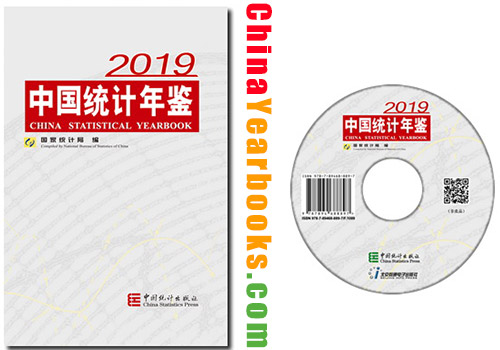
I. China Statistical Yearbook 2019 is an annual statistical publication, which reflects comprehensively the economic and social development of China. It covers data for 2018 and key statistical data in recent years and some historically important years at the national level and the local levels of province, autonomous region and municipality directly under the Central Government.
II. The Yearbook contains twenty-eight chapters: l. General Survey; 2. Population; 3. National Accounts; 4. Employment and Wages; 5. Prices; 6. People’s Living Conditions; 7. Government Finance; 8. Resources and Environment; 9. Energy; 10. Investment in Fixed Assets; 11. Foreign Trade and Economic Cooperation; 12. Agriculture; 13. Industry; 14. Construction; 15. Wholesale and Retail Trades; 16. Transport, Postal and Telecommunication Services, and Software Industry; 17. Hotels, Catering Services and Tourism; 18. Financial Intermediation; 19. Real Estate; 20. Science and Technology; 21. Education; 22. Public Health and Social Services; 23. Culture and Sports; 24. Public Management, Social Security and Social Organizations; 25. Urban, Rural and Regional Development; 26. Main Social and Economic Indicators of Hong Kong Special Administrative Region (SAR); 27. Main Social and Economic Indicators of Macao Special Administrative Region (SAR); 28. Main Social and Economic Indicators of Taiwan Province. One chapter listed as Appendix is Main Social and Economic Indicators of Other Countries/Regions.
To facilitate readers, the Brief Introduction at the beginning of each chapter provides a summary of the main contents of the chapter, data sources, statistical scope, statistical methods and historical changes. At the end of each chapter, Explanatory Notes on Main Statistical Indicators are included.
III. The national data in this book do not include those of the Hong Kong Special Administrative Region, the Macao Special Administrative Region and Taiwan Province, except for the divisions of administrative areas, the area of the national territory and forest resources and otherwise specified. In accordance with the principles set down in the Basic Law of Hong Kong Special Administrative Region, and the Basic Law of Macao Special Administrative Region, statistically Hong Kong, Macao and the mainland of China are three mutually independent regions, each following its own and different statistical systems and legal provisions in conducting statistical operations independently. Statistics on the Hong Kong Special Administrative Region and the Macao Special Administrative Region as included in this yearbook are provided by the Census and Statistics Department of the Government of Hong Kong Special Administrative Region and the Statistics and Census Service of the Government of Macao Special Administrative Region respectively; and are edited by the National Bureau of Statistics.
IV. Eastern region, central region, western region and northeastern region in the Yearbook are divided as following:
Eastern 10 provinces (municipalities) include: Beijing, Tianjin, Hebei, Shanghai, Jiangsu, Zhejiang, Fujian, Shandong, Guangdong and Hainan;
Central 6 provinces include: Shanxi, Anhui, Jiangxi, Henan, Hubei and Hunan;
Western 12 provinces (autonomous regions and municipalities) include: Inner Mongolia, Guangxi, Chongqing, Sichuan, Guizhou, Yunnan, Tibet, Shaanxi, Gansu, Qinghai, Ningxia and Xinjiang;
Northeastern 3 provinces include: Liaoning, Jilin and Heilongjiang.
V. The units of measurement used in the Yearbook are internationally standard measurement units, and newly published and implemented Product Categories are uniformly used.
VI. Please refer to the newly published version of the Yearbook for updated historical data. Statistical discrepancies on totals and relative figures due to rounding are not adjusted in the Yearbook.
VII. Notations used in the Yearbook: (blank space) indicates that the data are unknown, or are not available; “#” indicates a major breakdown of the total; and “*”or “①”indicates footnotes at the end of the table. About the notations in the chapters of Hong Kong SAR and Macao SAR, please refer to the brief introduction in relevant chapters.
VIII. In comparison with China Statistical Yearbook 2018, following revisions have been made in this new version in terms of the statistical contents and in editing: Of the chapter “National Accounts”, value-added by sector of gross regional product and relevant indicators of gross regional product (by income approach and by expenditure approach) are deleted. Of the chapter “Resources and Environment”, table of Identified Reserves of Major Minerals are added. Of the chapter “Investment in Fixed Assets”, amount indicators change to relative indicators such as growth rate and proportion, and tables of Total Investment in Fixed Assets by Three Strata of Industry and Non-governmental Investment in Fixed Assets are added. Of the chapter “Foreign trade and Economic Cooperation”, indicator of net overseas direct investment (flow) are added. Of the chapter “Industry”, with industrial enterprises above designated size, indicators of revenue (cost) from principal business change into business revenue (cost). Of the chapter “Wholesale and Retail Trades”, tables of Sales of Passenger Cars and Sales of Second-hand Passenger Cars are added. Of the chapter “Transport, Postal and Telecommunication Services, and Software Industry”, indicators of fixed telephone, household telephone, public telephone, roaming services, dial-up Internet access are deleted. Data of 2018 in some tables are absent, because the data verification of the Fourth Economic Census is in progress.
China Statistical Yearbook 2018 PDF Download
Yearbook title:中国统计年鉴2018
Yearbook English title:China Statistical Yearbook 2018
Publisher : China Statistics Press
Published Date : 9/2018
Frequency : Annually
Language : English and Chinese bilingual
ISBN/ISSN : 978-7-5037-8587-0
Availability : Printed Version;Electronic Version(PDF & CD)
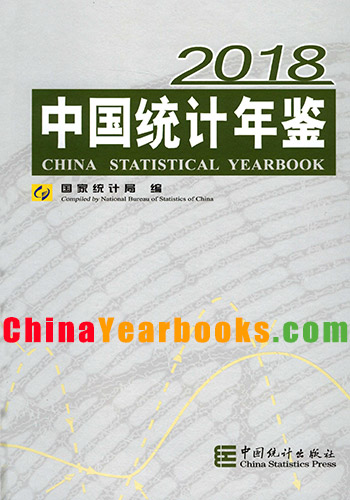
Ⅰ.China Statistical Yearbook 2018 is an annual statistical publication,which reflects comprehensively the economic and socialdevelopment of China.It covers data for 2017 and key statistical data in recent years and some historically important years at thenational level and the local levels of province,autonomous region and municipality directly under the Central Government. Ⅱ.The Yearbook contains twenty-eight chapters:1.General Survey;2.Population;3.National Accounts;4.Employment andWages;5.Prices;6.People’s Living Conditions;7.Government Finance;8.Resources and Environment;9.Energy;10.Investmentin Fixed Assets;11.Foreign Trade and Economic Cooperation;12.Agriculture;13.Industry;14.Construction;15.Wholesale andRetail Trades;16.Transport,Postal and Telecommunication Services,and Software Industry;17.Hotels,Catering Services andTourism;18.Financial Intermediation;19.Real Estate;20.Science and Technology;21.Education;22.Public Health and SocialServices;23.Culture and Sports;24.Public Management,Social Security and Social Organizations;25.Urban,Rural and RegionalDevelopment;26.Main Social and Economic Indicators of Hong Kong Special Administrative Region(SAR);27.Main Social andEconomic Indicators of Macao Special Administrative Region(SAR);28.Main Social and Economic Indicators of Taiwan Province.One chapter listed as Appendix is Main Social and Economic Indicators of Other Countries/Regions. To facilitate readers,the Brief Introduction at the beginning of each chapter provides a summary of the main contents of thechapter,data sources,statistical scope,statistical methods and historical changes.At the end of each chapter,Explanatory Notes onMain Statistical Indicators are included. Ⅲ.The national data in this book do not include those of the Hong Kong Special Administrative Region,the Macao SpecialAdministrative Region and Taiwan Province,except for the divisions of administrative areas,the area of the national territory andforest resources and otherwise specified.In accordance with the principles set down in the Basic Law of Hong Kong SpecialAdministrative Region,and the Basic Law of Macao Special Administrative Region,statistically Hong Kong,Macao and themainland of China are three mutually independent regions,each following its own and different statistical systems and legalprovisions in conducting statistical operations independently.Statistics on the Hong Kong Special Administrative Region and theMacao Special Administrative Region as included in this yearbook are provided by the Census and Statistics Department of theGovernment of Hong Kong Special Administrative Region and the Statistics and Census Service of the Government of MacaoSpecial Administrative Region respectively;and are edited by the National Bureau of Statistics. Ⅳ.Eastern region,central region,western region and northeastern region in the Yearbook are divided as following: Eastern 10 provinces(municipalities) include:Beijing,Tianjin,Hebei,Shanghai,Jiangsu,Zhejiang,Fujian,Shandong,Guangdong and Hainan; Central 6 provinces include:Shanxi,Anhui,Jiangxi,Henan,Hubei and Hunan; Western 12 provinces(autonomous regions and municipalities) include:Inner Mongolia,Guangxi,Chongqing,Sichuan,Guizhou,Yunnan,Tibet,Shaanxi,Gansu,Qinghai,Ningxia and Xinjiang; Northeastern 3 provinces include:Liaoning,Jilin and Heilongjiang. Ⅴ.The units of measurement used in the Yearbook are internationally standard measurement units,and newly published andimplemented Product Categories are uniformly used. Ⅵ.Please refer to the newly published version of the Yearbook for updated historical data.Statistical discrepancies on totals andrelative figures due to rounding are not adjusted in the Yearbook. Ⅶ.Notations used in the Yearbook:(blank space) indicates that the data are unknown,or are not available;”#” indicates amajor breakdown of the total;and “*”or “①”indicates footnotes at the end of the table.About the notations in the chapters of HongKong SAR and Macao SAR,please refer to the brief introduction in relevant chapters. Ⅷ.In comparison with China Statistical Yearbook 2017,following revisions have been made in this new version in terms ofthe statistical contents and in editing:Of the chapter “National Accounts”,indicators of exports of goods and services,imports ofgoods and services,2015 Input-Output table are added.Of the chapter “Employment and Wages”,figures from State Administrationfor Market Regulation are listed separately,relevant table frames are adjusted.Of the chapter “Resources and Environment”,indicators of ensured reserves of minerals are deleted.Of the chapter “Investment in Fixed Assets”,tables of Floor Space ofBuildings under Construction and Completed,Construction Size of Main Production Capacity are deleted.Of the chapter “Foreigntrade and Economic Cooperation”,indicators of export and import of services in RMB are added.Of the chapter “Agriculture”,according to the result of the Third National Agricultural Census,relevant historical data are revised.Of the chapter “FinancialIntermediation”,table of share issued is adjusted.Of the chapter “Education”,table of Number of Students of Non-formal Educationis added.Of the chapter “Public Health and Social Services”,table of Statistics on Community Service Facilities and Social Workersis deleted.Of the chapter “Culture and Sports”,table of Technology Statistics on Radio and TV is deleted.Of the chapter “Urban,Rural and Regional Development”,table of Level of Municipal Public Facilities of Built-up Area of Towns is deleted.
Statistical Yearbook of the Belt and Road Countries 2017 Download
Mongolia
Main Indicators on National Economic in Mongolia
The Socialist Republic of Viet Nam
Main Indicators on National Economic in Vietnam
The Lao People’s Democratic Republic
Main Indicators on National Economic in Lao PDR
Kingdom of Cambodia
Main Indicators on National Economic in Cambodia
The Republic of the Union of Myanmar
Main Indicators on National Economic in Myanmar
The Kingdom of Thailand
Main Indicators on National Economic in Thailand
Malaysia
Main Indicators on National Economic in Malaysia
Republic of Singapore
Main Indicators on National Economic in Singapore
Republic of Indonesia
Main Indicators on National Economic in Indonesia
Republic of the Philippines
Main Indicators on National Economic in Philippines
Brunei Darussalam
Main Indicators on National Economic in Brunei
Democratic Republic of Timor-Leste
Main Indicators on National Economic in Timor-Leste
The Democratic Socialist Republic of Sri Lanka
Main Indicators on National Economic in Sri Lanka
The Republic of Maldives
Main Indicators on National Economic in Maldives
The Islamic Republic of Pakistan
Main Indicators on National Economic in Pakistan
The Republic of India
Main Indicators on National Economic in India
The People’s Republic of Bangladesh
Main Indicators on National Economic in Bangladesh
The Federal Democratic Republic of Nepal
Main Indicators on National Economic in Nepal
The Kingdom of Bhutan
Main Indicators on National Economic in Bhutan
The Islamic Republic of Afghanistan
Main Indicators on National Economic in Afghanistan
The Islamic Republic of Iran
Main Indicators on National Economic in Iran, Islamic Rep.
Republic of Turkey
Main Indicators on National Economic in Turkey
The Syrian Arab Republic
Main Indicators on National Economic in Syrian
The Republic of Lebanon
Main Indicators on National Economic in Lebanon
The State of Palestine
The State of Palestine
The State of Israel
Main Indicators on National Economic in Israel
The Hashemite Kingdom of Jordan
Main Indicators on National Economic in Jordan
The Republic of Iraq
Main Indicators on National Economic in Iraq
The State of Kuwait
Main Indicators on National Economic in Kuwait
Kingdom of Saudi Arabia
Main Indicators on National Economic in Saudi Arabia
The Republic of Yemen
Main Indicators on National Economic in Yemen
The Sultanate of Oman
Main Indicators on National Economic in Oman
The United Arab Emirates
Main Indicators on National Economic in United Arab Emirates
The State of Qatar
Main Indicators on National Economic in Qatar
The Kingdom of Bahrain
Main Indicators on National Economic in Bahrain
Turkmenistan
Main Indicators on National Economic in Turkmenistan
The Republic of Uzbekistan
Main Indicators on National Economic in Uzbekistan
Kyrgyz Republic
Main Indicators on National Economic in Kyrgyz Republic
The Republic of Tajikistan
Main Indicators on National Economic in Tajikistan
The Republic of Kazakhstan
Main Indicators on National Economic in Kazakhstan
The Republic of Poland
Main Indicators on National Economic in Poland
The Czech Republic
Main Indicators on National Economic in Czech Republic
The Slovak Republic
Main Indicators on National Economic in Slovak Republic
Hungary
Main Indicators on National Economic in Hungary
The Republic of Slovenia
Main Indicators on National Economic in Slovenia
The Republic of Croatia
Main Indicators on National Economic in Croatia
Romania
Main Indicators on National Economic in Romania
The Republic of Bulgaria
Main Indicators on National Economic in Bulgaria
The Republic of Serbia
Main Indicatorson National Economic in Serbia
Montenegro
Main Indicatorson National Economic in Montenegro
The Republic of Macedonia
Main Indicatorson National Economic in Macedonia
Bosnia and Herzegovina
Main Indicatorson National Economic in Bosnia and Herzegovina
The Republic of Albania
Main Indicatorson National Economic in Albania
The Republic of Estonia
Main Indicators on National Economic in Estonia
The Republic of Lithuania
Main Indicators on National Economic in Lithuania
The Republic of Latvia
Main Indicators on National Economic in Latvia
The Republic of Belarus
Main Indicators on National Economic in Belarus
Ukraine
Main Indicators on National Economic in Ukraine
The Republic of Moldova
Main Indicators on National Economic in Moldova
The Russian Federation
Main Indicators on National Economic in Russian
The Republic of Azerbaijan
Main Indicators on National Economic in Azerbaijan
The Republic of Armenia
Main Indicators on National Economic in Armenia
Georgia
Main Indicators on National Economic in Georgia
The Arab Republic of Egypt
Main Indicators on National Economic in Egypt
China
Main Indicators on National Economic in China
Explanatory Notes on Main Statistical Indicators
Explanatory Notes on Main Statistical Indicators
Publisher : China Statistics Press
Published Date : 08/2017
Frequency : Annually
Language : English and Chinese bilingual
ISBN/ISSN : 978-7-5037-8294-7
Weight : 3.10kg
Availability : Printed Version;Electronic Version(PDF )
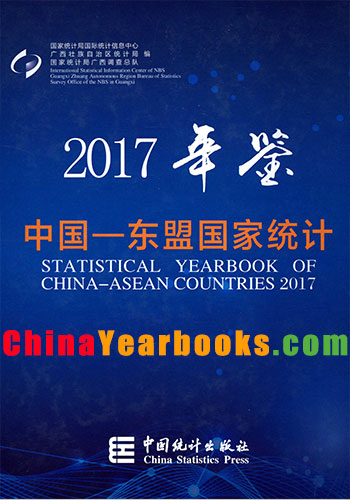
Ⅰ.Statistical Yearbook of China-ASEAN 2017(hereinafter referred to as the Yearbook) is an annual statistical publication,which reflects the economic and social development of China and 10 ASEAN countries.It covers data for 2016 and key statistical data for important years. Ⅱ.The Yearbook contains two chapters:1.Main Economic Indicators of China-ASEAN Countries;2.Main Economic & Social Indicators of China and ASEAN Countries.Chapter One covers main statistical data of China-ASEAN in general since 2005.Chapter Two introduces main statistical data of economy,trade and investment of China and 10 ASEAN countries in details. Ⅲ.Sources of data in the Yearbook:data in Chapter One are mainly from World Bank Databases and ASEAN Databases,which are excerpted by International Information Center of National Bureau of Statistics of China(NBS).While data in Chapter Two come from National Statistical Offices of ASEAN Countries and the ASEAN Secretariat,and be compiled by Guangxi Zhuang Autonomous Region Bureau of Statistics. Ⅳ.The units of measurement used in the Yearbook are internationally standard measurement units. Ⅴ.Statistical discrepancies on totals and relative figures due to rounding are not adjusted in the Yearbook. Ⅵ.Notations used in the Yearbook: “…”indicates that the figure is not large enough to be measured with the smallest unit in the table; “Blank space” indicates that the data are unknown or are not available; “#”indicates a major breakdown of the total. Ⅶ.In view of various sources,footnotes are made for each data.Readers should notice that when using the data. Ⅷ.Acknowledgements:our great gratitude goes to relevant units and staffs,from which we have received tremendous support when compiling the Yearbook.Mistakes may appear due to limited time for compiling.Please point out for correction if any.