Shandong Statistical Yearbook 2021

Shandong Statistical Yearbook 2021 Download

Yearbook title:山东统计年鉴2021
Yearbook English title:Shandong Statistical Yearbook 2021
Published Date :10/2021
Language : English and Chinese bilingual
Availability : Printed Version;Electronic Version(PDF Version)
Shandong Statistical Yearbook 2021

Ⅰ.Shandong Statistical Yearbook is an annual publication,which covers very comprehensive data and reflects various aspects of Shandong’s social and economic development.It can also work as an important and historical reference book which will play a great role in comprehending and studying the basic conditions of Shandong,making policies,and guiding the development of society and economy. Ⅱ.The yearbook contains the following two parts:part one statistical tables and part two appendixes. Statistical tables contain the following twenty-two chapters,1.General Survey;2.National Accounts;3.Population;4.Employment,Wages and Social Security;5.Investment in Fixed Assets;6.Foreign Trade and Tourism;7.Energy;8.Government Finance and Banking;9.Price Indices;10.People’s Livelihood;11.City Construction;12.Natural Resources and Environment;13.Agriculture;14.Industry;15.Construction;16.Service Enterprise;17.Transport,Postal and Telecommunication Services;18.Wholesale,Retail,Hotels and Catering Services;19.Education,Science and Technology;20.Culture,Sports and Health;21.Public Management and Social Services;22.Main Indicators of Counties(Cities and Districts at County Level). In brief introduction at the beginning of each chapter,main coverage of this chapter,data sources and statistical coverage are concerned.In addition,explanatory notes on main statistical indicators are provided at the end of each chapter,giving a brief explanation of statistical indicators,such as definition,statistical methods,statistical coverage and statistical scope. Appendixes contain the main economic indicators of some other provinces(municipality),international statistics,Shandong Statistics Communique and Shandong Statistical Undertaking.Shandong Statistical Undertaking contains Summary and Events of Shandong Provincial Bureau of Statistics. Ⅲ.Data used in Shandong Statistics Communique are preliminary statistics.Data in other chapters is official annual data.Data in Shandong Statistical Yearbook are all verified and should be based on this standard. Ⅳ.In Shandong Statistical Yearbook,statistical definitions,statistical coverage,statistical methods and prices are adjusted according to the current state statistical standards,and all changes have been noted at the end of the table or in the explanatory notes.Data in value terms are calculated at current prices if there are no notes.Statistical discrepancies on totals and relative figures due to rounding are not adjusted. Ⅴ.After this yearbook was published,it has received lots of concerns and support from readers whom we should thank.Because of our ability,it is inevitable that there are shortcomings in this book,so we welcome all candid comments and criticism from our readers to perfect this book and to offer readers better service.
Yunnan Statistical Yearbook 2021

Yunnan Statistical Yearbook 2021 Download

Yearbook title:云南统计年鉴2021
Yearbook English title:Yunnan Statistical Yearbook 2021
Published Date :11/2021
Language : English and Chinese bilingual
Availability : Printed Version;Electronic Version(PDF Version)

Yunnan Statistical Yearbook 2021

Ⅰ.Yunnan Statistical Yearbook 2021 is an annual statistics reference book which fully reflects the national economy and social development in Yunnan province.The present yearbook covers comprehensive data in each city,county and prefecture in 2020 as well as some key data in significant years of the whole province. Ⅱ.After revision,this book contains the following eighteen parts:1.Provincial survey;2.Economies;3.Investment in Fixed Assets;4.Urban and Rural Consumption;5.Public Finance;6.Foreign Trade;7.Agriculture and Country;8.Industry and Energy;9.Construction and Real Estate;10.Transport and Communications Industry;11.Banking and Insurance;12.Tourism;13.Education,Science and Technology and Culture;14.Public Health,Sports and Social Services;15.Population and Employment;16.Resources and Environment;17.Survey of National Autonomous Area;18.Survey of Intra-county Economies. Ⅲ.Explanatory Notes on Principal Statistical Indicators are provided at the end of each part to describe the content,scope and method of provincial statistical indicators briefly.The major data in this publication are obtained from annual statistical reports.It is advisable to note in the reference that the sum of data of each city,county and prefecture may not correspondingly equal the total of the whole province in some statistical indicators due to different statistical ranges and investigation methods.As for changes of statistical ranges,the relevant data are adjusted and explained accordingly in the present yearbook. Ⅳ.The units of measurement used in this book are international standard measurement units issued by the state.Notations used in this yearbook,”(Blank)” indicates that the data are not available;or refers to numbers of minimum units or refers to numbers which are not in detail.”#” indicates that the major items of the total.Ⅴ.Thanks for the great support and attention given by party members and governments at each level,and colleagues who participate in this editing work.In order to perfect the yearbook and meet the requirements of the society better,comments from various readers are highly appreciated.At the same time,readers are welcome to correct our mistakes made in this book.

Jiangxi Statistical Yearbook 2021

Jiangxi Statistical Yearbook 2021 Download

Yearbook title:江西统计年鉴2021
Yearbook English title:Jiangxi Statistical Yearbook 2021
Published Date :09/2021
Language : English and Chinese bilingual
Availability : Printed Version;Electronic Version(PDF Version)

Jiangxi Statistical Yearbook 2021

Ⅰ.Jiangxi Statistical Yearbook 2021 is an annual statistics publication,which reflects comprehensively the economic and social development of Jiangxi province.It covers data for 2020 and some selected data series in historically important years and the most recent forty years at level of province and other provinces and municipalities. Ⅱ.The yearbook contains the following twenty-one chapters,General Survey;Population;Employment and Wages;Investment in Fixed Assets;Energy;Price Indices;People’s Livelihood;General Survey of Cities;Ecological Environment;Agriculture;Industry;Construction;Transport,Post and Telecommunication Services;Domestic Trade;Foreign Trade and Economic Cooperation;Tourism;Financial Intermediation;Insurance;Real Estate;Education,Science and Technology;Culture,Sports and Public Health;Social Welfare and Other Social Activities;Main Statistical Indictors on provinces,autonomous regions and municipalities and Notes of Jiangxi Statistical Events in 2020.For readers’ convenience,in Brief Introduction at the beginning of each chapter,main coverage of this chapter,data sources,statistical coverage,statistical methods and historical changes are concerned In addition,Explanatory Notes on Main Statistical Indicators are provided at the end of each chapter. Ⅲ.This yearbook re-audited statistic data published previously,any data different from this yearbook,take this yearbook’s as standard data. Ⅳ.The units of measurement used in this yearbook are intemationally standard measurement units. Ⅴ.Statistical discrepancies due to rounding are not adjusted in the yearbook. Ⅵ.Notations used in the yearbook:blank space indicates that the figure is not large enough to be measured with the smallest unit in the table,or data are unknown or are not available;”#” indicates a major breakdown of the total.

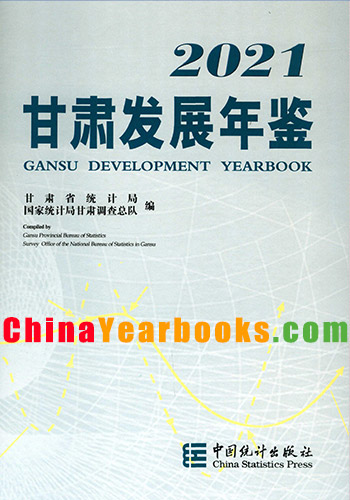
Gansu Development Yearbook 2021

Gansu Development Yearbook 2021 Download

Yearbook title:甘肃发展年鉴2021
Yearbook English title:Gansu Development Yearbook 2021
Published Date :11/2021
Language : English and Chinese bilingual
Availability : Printed Version;Electronic Version(PDF Version)

Gansu Development Yearbook 2021

Ⅰ.Gansu Development Yearbook,edited by the Gansu Provincial Bureau of Statistics and Survey Office of the National Bureau of Statistics in Gansu and published by china statistics press,is a large-scale domestic and international public offering comprehensive annual publication.It records comprehensively Gansu economic and social development situation by the large amount of reliable data,and is an important tool to understand the situation of the province,city and conduct a scientific decision-making,consult and research for every level party and government leaders,economic management department,enterprise and public institution,research departments and domestic and foreign investors. Ⅱ.The yearbook is the twelfth volume since founded,which is all the in Chinese-English and equipped with electronic version,records mainly Gansu economic and social development situation in 2020,but its statistics materials have traced back in time. Ⅲ.The yearbook contains the following two parts:The first part contains Featured Articles,Survey,National Economy,Traffic Communication,Government Finance and Financial,Economy & Management,Social Undertaking,People’s Living Conditions,City & County and Lanzhou New Area Overview,total 9 chapters.The second part contains total 23 sections and chapters:General Survey;Population;National Accounts;Employment and Wages;Prices;People’s Living Conditions;Government Finance and Financial Intermediation;Resources and Environment;Energy;Investment in Fixed Assets;Foreign Trade and Economic Cooperation;Agriculture;Industry;Construction;Wholesale and Retail Trades;Hotels,Catering Services and Tourism;Transport,Postal and Telecommunication Services;Education & Science and Technology;Public Health,Social Services and Social Security;Culture and Sports;City;Ethnic Minority Autonomous Area;Lanzhou New Area.For the convenience of using information for the readers,statistics have a brief introduction at the beginning of each part.In addition,explanatory notes on main statistical indicators are provided at the end of each part. Ⅳ.The yearbook style is divided into contents,subhead and entry three levels,and entry as the basic structural unit.The entry titles are in bold and add []. Ⅴ.In comparison with Gansu Development Yearbook 2020,following amendments were mainly made in content of this yearbook:In the first part,the chapter of “City & State and Lanzhou New Area Overview” is changed into”City & County and Lanzhou New Area Overview”.In the second part,the chapter of “Population”,9 tables including”Household,Population,Sex Ratio and Household Size by Region(The Seventh National Census)” are added according to the Seventh National Population Census data,table of “Total Household and Total Population by Region & County”(Household population) are deleted;the chapter of “Prices”,deleted the relevant content of the “Price Index for Investment in Fixed Assets”;the chapter of “People’s Living Conditions”,table of “Per Capita Income and Consumption Expenditure of Gansu Residents ” is added;the chapter of “Government Finance and Financial Intermediation “,indicator of “Expenditure of Special Treasury Bonds for Against COVID-19” is added in the table of “Revenue and Expenditure of Government Fund”;the chapter of “Investment in Fixed Assets”,table of “Growth Rate of Investment in Fixed Assets by Industry” is added. Ⅵ.As the methods of statistical system reform,some of the caliber of statistical indicators,including the scope and computational method change and please note that when used.The presentation data is provided by the units and some are preliminary statistics,if they does not accord with the statistical tables to tables shall prevail. Ⅶ.According to the results of the Seventh National Population Census,the 2011-2019 data of indicators related to”per capita” involved in this yearbook are revised. Ⅷ.Please refer to the newly published version of the yearbook for updated historical data.The units of measurement used in this yearbook are internationally standard measurement units,statistical discrepancies on totals and relative figures due to rounding are not adjusted in the yearbook. Ⅸ.Notations used in the yearbook:(blank space) indicates that the figure is not large enough to be measured with the smallest unit in the table,or data are unknown,or are not available;”#” indicates a major breakdown of the total. The edit and publishing of the yearbook were strongly supported by the departments under the provincial leadership,relevant enterprises and public institutions.We express our sincere thanks!

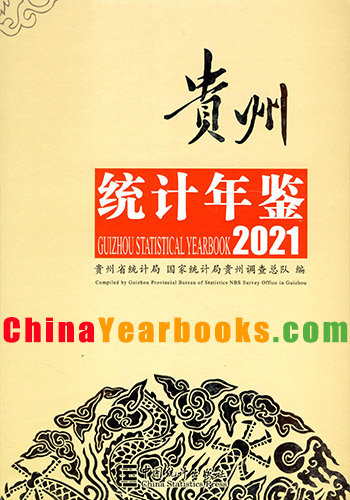
Guizhou Statistical Yearbook 2021

Guizhou Statistical Yearbook 2021 Download

Yearbook title:贵州统计年鉴2021
Yearbook English title:Guizhou Statistical Yearbook 2021
Published Date :09/2021
Language : English and Chinese bilingual
Availability : Printed Version;Electronic Version(PDF Version)

Guizhou Statistical Yearbook 2021

Ⅰ.Guizhou Statistical Yearbook 2021 is an annual statistical publication,it systematically includes the statistical data,which reflects comprehensively the economic and social development of Guizhou Province.It covers data of year 2020,key statistical data for the years since Reformand opening-up specially the year 2016,and Main Statistics of Province(autonomous regions,municipalities)as well as the whole country.It is a useful reference book to thoroughly know Guizhou. Ⅱ.The yearbook contains 26 chapters:General Survey;National Accounts;Population;Employment and Wage;Investment in Fixed Assets;Foreign Trade and Economic Cooperation;Energy;Government Finance and Taxation;Price Indices;Peoples Living Conditions;General Information of Cities;Resources and Environment;Agriculture;Industry;Construction;Trans port,Post and Telecommunication Services;Wholesale and Retail Trades;Hotel,Catering Serv-ices and Tourism;Financial Intermediation;Education,Science and Technology;Culture,Sports and Public Health;Social Services and Others;Minority Nationality Autonomous Areas;Main Statistics of Prefectures and Counties;Main Statistics of Provinces(autonomous regions,municipalities)and the Whole Country.Explanatory Notes on Main Statistical Indicators is atta-ched to the end of each chapter to help the readers to use the statistical data in this book. Ⅲ.Data sources are indicated below the statistical tables where data are provided by the departments(units)concerned.Some of the statistical range and caliber of indicators have changed,all of which are annotated at the bottom of the table. Ⅳ.Statistical discrepancies on totals and relative figures due to rounding are not adjusted in the yearbook. Ⅴ.Notations used in the yearbook:”…” indicates that the figure is not large enough to be measured with the smallest unit in the table;”blank space”indicates that data are unknown or are not available;”#” indicates one of the parent indices.

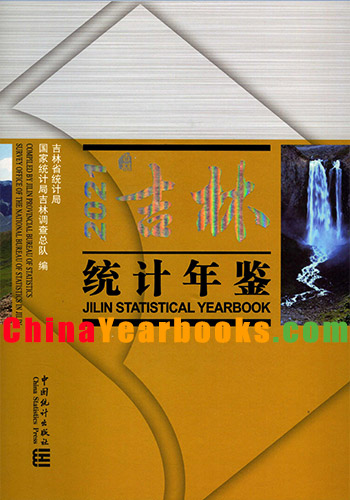
Jilin Statistical Yearbook 2021

Jilin Statistical Yearbook 2021 Download

Yearbook title:吉林统计年鉴2021
Yearbook English title:Jilin Statistical Yearbook 2021
Published Date :11/2021
Language : English and Chinese bilingual
Availability : Printed Version;Electronic Version(PDF Version)

Jilin Statistical Yearbook 2021

Ⅰ.Jilin Statistical Yearbook 2021 is annual statistics publication,which cover very comprehensive data series for 2020 and some selected data series for historically important years in whole province,cities(prefecture) and counties and therefore,reflects various aspects of social and economic development. Ⅱ.The Content is Divided into 19 parts,i.e.1.Synthesis;2.National Economic Accounting;3.Population;4.Employment and Wage;5.Investment in Fixed Assets;6.Foreign Economy Trade and Tourism;7.Production and Consumption of Energy;8.Public Finance,Banking and Insurance;9.Price Indices;10.People’s Livelihood;11.Urban Public Utilities;12.Agriculture;13.Industry;14.Construction;15.Transportation Postal and Telecommunications Services;16.Wholesale,Retail Trade and Catering Services;17.Education,Technology and Culture;18.Sports,Public Health and Others;19.General Survey of City(State) and County(City).In the appendices listed:Explanatory Notes on Main Statistical Indicators. Ⅲ.The units of measurement used in this book are internationally standard measurement units. Ⅳ.In the yearbook some data total numbers or relative number because of units chosen differential Causing generating calculation error,no mechanical adjust. Ⅴ.Historical data in this yearbook related to the economic census are revised according to the Fourth National Economic Census. Ⅵ.Explanatory notes for notations used in this book:”blank” indicated that the index data not available or no dale;”#”of which:major item. Ⅶ.We’d like to send our sincere acknowledgement various units and comrades for their vigorous assistances during the edition and translation of this yearbook.Due to our limited ability and the hasty time,faults and shortage are unavoidable.Any criticism or suggestion is appreciated.

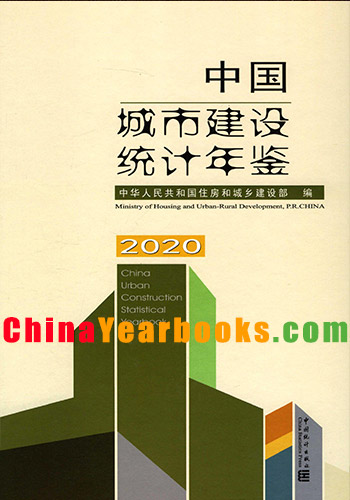
China Urban Construction Statistical Yearbook 2020

China Urban Construction Statistical Yearbook 2020 Download

Yearbook title:中国城市建设统计年鉴2020
Yearbook English title:China Urban Construction Statistical Yearbook 2020
Published Date :09/2021
Language : English and Chinese bilingual
Availability : Printed Version;Electronic Version(PDF Version)

China Urban Construction Statistical Yearbook 2020

1.China Urban-Rural Construction Statistical Yearbook,China Urban Construction Statistical Yearbook and China County Seat Construction Statistical Yearbook are published annually in both Chinese and English languages to provide comprehensive information on urban and rural service facilities development in China.Being the source of facts,the yearbooks help to facilitate the understanding of people from all walks of life at home and abroad on China’s urban and rural development. 2.2020 China Urban Construction Statistical Yearbook is compiled based on statistical data on urban construction in year 2020 and past years that were reported by construction authorities of provinces,autonomous regions and municipalities directly under the central government.This yearbook is composed of 13 parts,including 1.Level of Urban Service Facilities,2.Urban Population and Construction Land,3.Revenue and Expenditure of Urban Maintenance and Construction Fund,4.Fixed Assets Investment in Urban Service Facilities,5.Urban Water Supply,6.Urban Water Conservation,7.Urban Gas,8.Urban Central Heating,9.Urban Rail Transit System,10.Urban Roads and Bridges,11.Urban drainage and Waste Water Treatment,12.Urban Environmental Sanitation,13.Urban landscaping. 3.Scope of the data collected from the survey covers urban area of cities,including(1) areas under the jurisdiction of neighborhood administration;(2) other towns(townships) connected to city public facilities,residential facilities and municipal utilities;(3) special areas like independent industrial and mining districts,development zones,research institutes,and universities and colleges with permanent residents of 3000 and above. 4.There were a total of 685 cities in all the 31 provinces,autonomous regions and municipalities(excluding Taiwan Province) across China by the end of 2020.In the Yearbook,data are from 684cities,3 special zones.Changbai Mountain Protection and Development District in Jilin Province,Yangling District in Shaanxi Province and Ningdong in ningxia Autonomous Region are classified as city. 5.Data from the county seats of 8 counties including Xingtai and Cangxian County in Hebei Province,Zezhou County in Shanxi Province,Fushun and Tieling County in Liaoning Province,Anyang County in Henan Province,and Urumqi and Hetian County in Xinjiang Autonomous Region are included in the Urban Construction Yearbook due to the identity of the location between the county seats and the cities administering the above 8 counties respectively. 6.This Yearbook does not include data of Hong Kong Special Administrative Region,Macao Special Administrative Region as well as Taiwan Province. 7.In this yearbook,“blank space” indicates that the figure is not large enough to be measured with the smallest unit in the table,or data are unknown or are not available. 8.The calculation errors of the total or relative value of some data in this Yearbook arising from the use of different measurement units have not been mechanically aligned. 9.Any comments to improve the quality of the yearbook are welcomed to promote the advancement in statistics in China’s construction industry.

China County Seat Construction Statistical Yearbook 2020

China County Seat Construction Statistical Yearbook 2020 Download

Yearbook title:中国县城建设统计年鉴2020
Yearbook English title:China County Seat Construction Statistical Yearbook 2020
Published Date :09/2021
Language : English and Chinese bilingual
Availability : Printed Version;Electronic Version(PDF Version)

China County Seat Construction Statistical Yearbook

1.Under the guideline of the Scientific Outlook on Development and in line with the efforts to promote the coordinated urban and rural development,China Urban-Rural Construction Statistical Yearbook,China Urban Construction Statistical Yearbook and China County Seat Construction Statistical Yearbook are published annually in both Chinese and English languages to provide comprehensive information on urban and rural service facilities development in China.Being the source of facts,the yearbooks help to facilitate the understanding of people from all walks of life at home and abroad on China’s urban and rural development. 2.2020 China County Seat Construction Statistical Yearbook is published for the first time.The book is compiled based on statistical data on County Seat construction in year 2020 and past years that were reported by construction authorities of provinces,autonomous regions and municipalities directly under the central government.This yearbook is composed of 12 parts,including 1.Level of County Seat Service Facilities,2.County Seat Population and Construction Land,3.Revenue and Expenditure of County Seat Maintenance and Construction Fund,4.Fixed Assets Investment in County Seat Service Facilities,5.County Seat Water Supply,6.County Seat Water Conservation,7.County Seat Gas,8.County Seat Central Heating,9.County Seat Roads and Bridges,10.County Seat drainage and Waste Water Treatment,11.County Seat Environmental Sanitation,and 12.County Seat landscaping.In each part,the data is classified by year,by region and by county. 3.Scope of the data collected from the survey covers county seat areas:(1) towns and townships where county governments are situated and areas under the jurisdiction of neighborhood administration;(2) other towns(townships) connected to county seat public facilities,residential facilities and municipal utilities;(3) special areas like independent industrial and mining districts,development zones,research institutes,and universities and colleges with permanent residents of 3000 and above. 4.In the Yearbook,data are from 1479 counties,16 special zones.Data of 9 counties are not included,for example,data from 8 counties including Xingtai and Cangxian County in Hebei Province,Zezhou County in Shanxi Province,Fushun and Tieling County in Liaoning Province,Anyang County in Henan Province,and Urumqi and Hetian County in Xinjiang Uygur Autonomous Region are included in the statistics of the respective cities administering the above counties due to the identity of the location between the county seats and the cities;data on Jinmen County in Fujian Province has not been available at the moment. 16 special zones and districts include Caofeidian and Baigouxincheng in Hebei Province,Yunzhou District and Taigu District in Shanxi Province,Jiagedaqi in Heilongjiang Province,Shennongjia Forestry District in Hubei Province,Wangcheng District,Nanyue District and Datong Lake District in Hunan Province,Yangpu Development Zone in Hainan Province,Liuzhite District and shuicheng District in Guizhou Province,Kunming Yangzonghai Scenic Spot in Yunnan Province,Hongsibao Development Zone in Ningxia Autonomous Region,and Xihai Town and Dachaidan Administrative Commission in Haibei Prefecture of Qinghai Province. 5.This Yearbook does not include data of Hong Kong Special Administrative Region,Macao Special Administrative Region as well as Taiwan Province. 6.In this yearbook,”blank space” indicates that the figure is not large enough to be measured with the smallest unit in the table,or data are unknown or are not available. 7.The calculation errors of the total or relative value of some data in this Yearbook arising from the use of different measurement units have not been mechanically aligned. 8.Faults inevitably exist in the data of the Yearbook due to the weak foundation of the data-collection work on county construction.Readers’ comments on how to make improvement are welcomed in order to jointly promote the work related to county construction statistics.

China Urban-Rural Construction Statistical Yearbook 2020

China Urban-Rural Construction Statistical Yearbook 2020  Download

Yearbook title:中国城乡建设统计年鉴2020
Yearbook English title:China Urban-Rural Construction Statistical Yearbook 2020
Published Date :09/2021
Language : English and Chinese bilingual
Availability : Printed Version;Electronic Version(PDF Version)

China Urban-Rural Construction Statistical Yearbook 2020

1.China Urban-Rural Construction Statistical Yearbook,China Urban Construction Statistical Yearbook and China County Seat Construction Statistical Yearbook are published annually in both Chinese and English languages to provide comprehensive information on urban and rural service facilities development in China.Being the source of facts,the yearbooks help to facilitate the understanding of people from all walks of life at home and abroad on China’s urban and rural development. 2.Coverage of the statistics Urban Areas:(1) areas under the jurisdiction of neighborhood administration;(2) other towns(townships)connected to urban public facilities,residential facilities and municipal utilities;(3) special areas like independent industrial and mining districts,development zones,research institutes,and universities and colleges with permanent residents of 3000 and above. County Seat Areas:(1) towns and townships where county governments are situated and areas under the jurisdiction of neighborhood administration;(2) other towns(townships) connected to county seat public facilities,residential facilities and municipal utilities;(3) special areas like independent industrial and mining districts,development zones,research institutes,and universities and colleges with permanent residents of 3000 and above. Villages and Small Towns Areas:towns,townships and special district at township level of which public facilities and residential facilities are not connected to those of cities(county seats). 3.There were a total of 685 cities,1483 counties(including autonomous counties,banners,autonomous banners,forest districts,and special districts),21157 towns,8809 townships(including minority townships,Sumus and minority Sumus),and 509 thousand administrative villages in all the 31 provinces,autonomous regions and municipalities across China by the end of 2020. 4.The yearbook is compiled based on statistical data on urban and rural construction in year 2020 that were reported by construction authorities of provinces,autonomous regions and municipalities directly under the central government.The yearbook is composed of statistics for three parts,namely statistics for cities(urban districts),county seats,and villages and small towns. (1) In the part of Cities(Urban Districts),data are from from 684 cities,3 special zones.Changbai Mountain Protection and Development District in Jilin Province,Yangling District in Shaanxi Province and Ningdong in ningxia Autonomous Region are classified as city. (2) In the part of County Seats,data is from 1479 counties,16 special zones and districts.Data from 8 counties including Xingtai and Cangxian County in Hebei Province,Zezhou County in Shanxi Province,Fushun and Tieling County in Liaoning Province,Anyang County in Henan Province,and Urumqi and Hetian County in Xinjiang Uygur Autonomous Region are included in the statistics of the respective cities administering the above counties due to the identity of the location between the county seats and the cities;data on Jinmen County in Fujian Province has not been available at the moment. 16 special zones and districts include Caofeidian and Baigouxincheng in Hebei Province,Yunzhou District and Taigu District in Shanxi Province,Jiagedaqi in Heilongjiang Province,Shennongjia Forestry District in Hubei Province,Wangcheng District,Nanyue District and Datong Lake District in Hunan Province,Yangpu Development Zone in Hainan Province,Liuzhite District and shuicheng District in Guizhou Province,Kunming Yangzonghai Scenic Spot in Yunnan Province,Hongsibao Development Zone in Ningxia Autonomous Region,and Xihai Town and Dachaidan Administrative Commission in Haibei Prefecture of Qinghai Province. (3) In the part of Villages and Towns,statistics is based on data from 18822 towns,8876 townships,447 special areas at the level of town and township,and 2.363 million natural villages including 493 thousand villages where villagers’ committees are situated. 5.This Yearbook does not include data of Hong Kong Special Administrative Region,Macao Special Administrative Region and Taiwan Province. 6.All the per capita and coverage rate data in this Yearbook,except the per capita residential floor area and per capita daily consumption of domestic water,are calculated using the sum of resident and non-resident population as a denominator. 7.In this yearbook,”blank space” indicates that the figure is not large enough to be measured with the smallest unit in the table,or data are unknown or are not available. 8.The calculation errors of the total or relative value of some data in this Yearbook arising from the use of different measurement units have not been mechanically aligned. 9.Any comments to improve the quality of the yearbook are welcomed to promote the advancement in statistics in China’s construction industry.