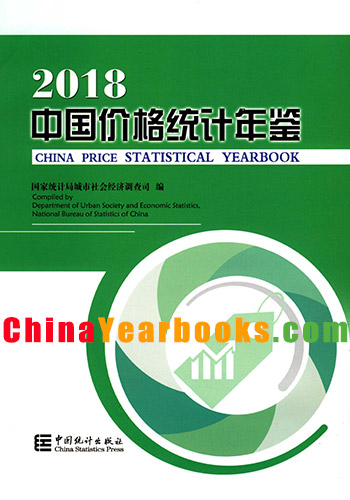
Yearbook title:中国价格统计年鉴2018
Yearbook English title:China Price Statistical Yearbook 2018
Publisher : China Statistics Press
Published Date : 8/2018
Frequency : Annually
Language : English and Chinese bilingual
Availability : Printed Version;Electronic Version(PDF)
China Price Statistical Yearbook 2018
Ⅰ.2018 China Price Statistical Yearbook is a professional annual statistics publication,which covers very comprehensive data in 2017 of price indices. Ⅱ.Data on price indices in this book includ mainly producer price indices for industrial products,purchasing price indices for industrial producers,priceindices for investment in fixed assets,consumer price indices,retail price indices,price indices for means of agricultural production,housing price index,showing the changing trends and the change rates in the prices of production,trade,consumption and investment. Ⅲ.Compilation of statistics on price indices is organized by the Department of Urban Social and Economic Survey,NBS.At levels of National Bureau of investigation team and relevant statistics in stitutions collect data in accordance with the scheme of price survey system,tabulate them and report them. Ⅳ.The national data in this yearbook do not include that of Hong Kong SAR(Special Administrative Region),Macao SAR and Taiwan province. Ⅴ.The units of measurement used in this yearbook are in accordance with internationally standard measurement units. Ⅵ.In this yearbook,“blank space”indicates that the data are unknown or are not available;“#”indicates a major breakdown of the total.
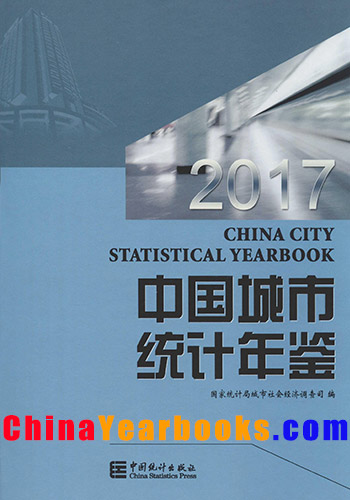
Yearbook title:中国城市统计年鉴2017
Yearbook English title:CHINA CITY STATISTICAL YEARBOOK 2017
Publisher : China Statistics Press
Published Date : 12/2017
Frequency : Annually
Language : English and Chinese bilingual
ISBN/ISSN : 978-7-5037-8432-3
Availability : Printed Version;Electronic Version(PDF & EXCEL)
CHINA CITY STATISTICAL YEARBOOK 2017
China City Statistical Yearbook is an annual statistical publication.China City Statistical Yearbook 2017 reflects comprehensively the economic and social development of Cities in China.It covers the main socio-economic statistical data of cities at all levels for 2016. The Yearbook contains four parts:Part Ⅰ is the administrative division of all cities,listing city distribution by region and level;Part Ⅱ and Part Ⅲ are the statistical data of cities at prefecture level and above,and county-level respectively on population,labour forces,land resources,general economy,industry,transport,postal and telecommunication services,commerce,foreign trade and economic cooperation,investment in fixed assets,education,culture,public health,people’s living conditions,social security,municipal public utilities,and environmental protection;Part Ⅳ is appendix of explanatory notes on main statistical indicators.It is necessary to point out that cities at prefecture level and above and county-level have used different indicator systems of statistics since1997,and some indicators in two categories of cities are not comparable.So the data of cities at prefecture level and above and the data of cities at county-level are divided into two independent parts in the yearbook. The national data in this yearbook do not include those of Hong Kong Special Administrative Region,Macao Special Administrative Region and Taiwan Province.“Total City” listed in the data refers to all administrative regions of the city,including the city districts,counties and the city at lower level;”Districts under City” includes all the city districts,not including counties and the city at lower level.The data of districts under Wuhan City do not include those of Huangpi district,Xinzhoudistrict,Jiangxia district and Caidian district.Some indicators of this yearbook are time-point data,the time of them is at the end of 2016. The Yearbook is compiled for the users working in government departments,city planning departments,institutes of urban socio-economic research,municipal construction and real estate agencies,intermediary services,information consulting agencies and other so on,and it is an important reference book for college teachers and students,businessmen,overseas investors as well as users paying close attention to the development of Chinese cities. The editing and publishing of the yearbook have been fully supported by the Department of Rural Surveys of NBS,Bureaus of Statistics and Survey Offices of NBS at provincial prefecture and county level,and China Statistics Press.Here we would like to express our heartfelt thanks to them. Department of Urban Surveys National Bureau of Statistics of China December,2017
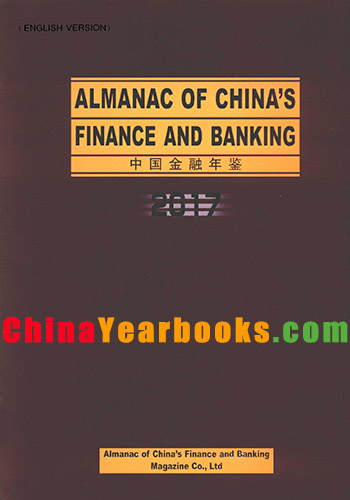
Almanac Of China’S Finance And Banking 2017 PDF Download
Yearbook title:中国金融年鉴(英文版)2017
Yearbook English title:Almanac Of China’S Finance And Banking 2017
Publisher : China Financial Yearbook magazine
Published Date : 3/2018
Frequency : Annually
Language : English
ISBN/ISSN : 1007-5607
Availability : Printed Version;Electronic Version(PDF)
Almanac Of China’S Finance And Banking 2017
the year 2016 was not only the beginning year of the decisive stage for China to complete the task of building a modestly prosperous society,but also the crucial year for the promotion of the supply-side structural reform.Under the leadership of the Central Committee of the Communist Party of China(CPC) and the State Council,the financial system strengthened and improved macroeconomic management,comprehensively deepened financial reform and opening-up,and effectively prevented financial risks,which created a favorable monetary and financial environment for stabilizing growth and carrying out the supply-side structural reform. Strengthening and Improving Macroeconomic Management,with the Sound Monetary Policy Better Targeted and More Effective In 2016,the world economy maintained an overall trend of recovery.However,uncertainties in the international political and economic arenas heightened further,and populism,anti-globalization,trade protectionism and investment protectionism were on the rise;the Chinese economy stabilized amid a slowdown and turned for the better,but the structural mismatches were still prominent,and the economy was still facing inadequate endogenous growth drivers.The macroeconomic management became more difficult due to the complex and changeable domestic and international economic and financial situations,various superimposed contradictions,and converged potential risks. Under such circumstances,by firmly implementing the strategic policy decision made by the CPC Central Committee and the State Council of stabilizing growth,adjusting structure and preventing risks by relying on reform and innovation instead of using the method of “flooding the cash” to stimulate the economy,the PBC proactively adapted to the new normal in economic development,maintained a prudent and sound monetary policy focusing especially on the pace,strength,and mix of policy tools in light of the evolving situation,to maintain appropriate liquidity.The PBC comprehensively adopted a series of monetary policy instruments,including targeted reserve requirementratio cuts,Pledged Supplement Lending(PSL),and central-bank lending for small enterprises and for poverty alleviation,to optimize the credit structure for supporting the development of the real economy.To further improve the macro-prudential policy framework,the PBC upgraded the dynamic adjustment mechanism of the differentiated required reserve to a Macro-Prudential Assessment(MPA) system.Full coverage of macro-prudential regulation of cross-border financing was implemented across the country to manage more financial activities and financial conducts.The counter-cyclical adjustment was implemented to prevent systemic risks.Transformation of the monetary policy framework was promoted,and the leveraging role of interest rate and exchange rate prices was brought into full play. In general,the sound monetary policy has yielded expected regulation results,with moderate growth of money,credit,and all-system financing aggregates,stable interest rates,a basically stable Renminbi exchange rate against a basket of currencies and increased flexibility of the bilateral Renminbi and the U.S.dollar exchange rate. Providing Financial Services for the Development of the Real Economy to Fully Support the Supply-side Structural Reform and Key National Development Strategies The PBC,the CBRC,the CSRC,the CIRC and other ministries jointly issued the Several Opinions on Providing Financial Support to the Industry in its Effort to Stabilize Growth,Adjust Structure and Increase Efficiency in a bid to provide financial support for the industrial supply-side structural reform.The creditors’ committee system was established and promoted to explore a variety of flexible and effective debt disposal methods.The PBC made concerted efforts to provide financial services to reduce capacity in the steel and coal industries and to bring about a smooth corporate debt financing transition in these industries.By closely focusing on the orientation of “housing is for living in not for speculation”,the PBC introduced the differentiated housing credit policy to promote the destocking of the real estate industry.The PBC carried out debt-equity swaps in a market-oriented manner and in compliance with the law to effectively promote deleveraging.It properly expanded corporate bond financing,and firmly promoted reduction of costs by lowering financial service charges.The PBC further carry forward the financial aid for targeted poverty alleviation and financial inclusion development,promoted financial support for the weak points in the economy and for economic development and social stability in the poverty-stricken and economically-backward regions,so as to shore up weak spots with great efforts. To meet the financing demand of the major strategic decisions of the state,the PBC provided more targeted and high value-added comprehensive financial services for the implementation of the “Belt and Road” Initiative,the growth of the Yangtze River economic belt,and the collaborative development of the Beijing-Tianjin-Hebei region and so on.The PBC mainly focused on supporting the key projects which serve as a driving force for the macro-economy and regional economy,such as renovation of shantytowns,major water conservancy projects,and railway and highway construction in the middle and western regions and so on.The PBC actively supported the “Made in China 2025″strategy,the transformation and upgrading of traditional industries,and the development of emerging industries with strategic importance and other key areas.The development of financial inclusion was accelerated by setting up a pilot reform zone for financial inclusion in Lankao County of Henan Province,so as to actively explore an innovative,coordinated,green,open and shared development model for the financial inclusion.The PBC made great efforts to develop the green finance,and through innovative green financial products and institutional arrangements,it guided and encouraged more private capital to be invested into the green industries,so as to promote the economic transformation and upgrading. Deepening the Financial Reform and Opening-up to Stimulate the Development Vitality and Dynamism of the Financial Industry The financial reforms in key areas and critical links of the financial sector were deepened,and the financial system has been increasingly improved.The PBC continued to thoroughly promote the market-based reforms of the Renminbi interest rates and exchange rates,further improved the central bank interest-rate adjustment framework,fostered the benchmark interest-rate system for the financial market,and continuously improved the self-regulatory mechanism for market interest-rate pricing.The PBC clarified the Renminbi/U.S.dollar central parity formation mechanism,namely “the previous closing rate+the exchange-rate movements of a basket of currencies”.The mechanism struck a balance between market supply and demand,the stability of the Renminbi exchange rate against a basket of currencies,and market expectations.It was also more rule-based,transparent,and market-oriented.Deepening of the reforms of financial institutions continued,with the corporate governance mechanism and business management system becoming increasingly modern and international,private banks developed in a steady pace,and the organizational structure system of the financial industry was further improved.Reforms of regional finance and financial inclusion were further promoted,and a green finance policy framework was established initially.The top-down systemic design of the commercial paper market was introduced,a centralized national commercial paper trading platform was put into service,and the Shanghai Commercial Paper Exchange was established. New progress was made in the Renminbi internationalization and the two-way opening up of the financial markets,China’s influence in the arena of governance of international finance has been enhancing.Renminbi was officially included in the SDR basket,which not only represented an important milestone in the Renminbi internationalization,but also an important step for China’s integration into the global financial system.The two-way opening up of the financial markets developed steadily,and more qualified foreign institutional investors were allowed to access into the interbank bond market,and the investment quotas were removed.On the basis of improving the Shanghai-Hong Kong Stock Connect program,the Shenzhen-Hong Kong Stock Connect program was launched,facilitating connectivity between the stock markets in Shanghai,Shenzhen and Hong Kong.Under its G20 presidency,China successfully held the G20 Hangzhou Summit,the PBC guided discussions on major global macroeconomic policies,reached important summit results on topics such as macroeconomic policy coordination,improving the international financial architecture,promoting financial sector reforms,and developing financial inclusion and green finance,which combined China’s philosophy and perspectives with global macroeconomic and financial governance. Effectively Preventing Financial Risks to Firmly Safeguard the Bottom-line in Terms of Preventing Systemic Financial Risks The prevention of financial risks is an eternal theme of financial work,especially under the circumstances of the increased downward pressure on the international and domestic economy and the increased spillover of the international financial crisis,the cyclical,structural and institutional contradictions in the domestic economy are superimposed with a trend of easy and frequent occurrence of financial risks,and the financial system has paid more attention to the prevention of risks. As a leading agency,by making overall arrangements to coordinate the CBRC,the CSRC and the CIRC,the PBC focused on preventing and mitigating financial risks in key areas.It improved regulatory arrangements for cross-market and cross-sector financial services and various comprehensive businesses,worked on formulating normative standards for asset management businesses,and organized and conducted a special rectification campaign on Internet financing risks.A differentiated risk-based premium mechanism was introduced in deposit insurance,an assessment of deposit insurance risks was carried out and the rating results were applied,and relevant research was conducted to improve risk recognition and an early rectification mechanism for the deposit insurance system was implemented in a bid to strengthen positive incentives.Default risks in the bond market were mitigated and resolved in an active manner and the interests of bond investors were protected. The financial regulation authorities conducted strict and comprehensive regulation and supervision according to law.The CBRC strengthened regulation of credit risks in key areas such as local government financing platform,real estate and excess capacity,investigated and punished violations of relevant regulations and rules such as the “downpayment lending” and “fake mortgage loans”,and it also explored market-based and diversified disposal of non-performing loans of financial institutions.The CSRC steadily and orderly regulated the use of excessively leveraged funds in the stock market and continued to clean up illegal margin financing,and organized targeted enforcement activities against such market misconducts as IPO frauds,market manipulation,and front running schemes,promoting the capital markets to stabilize through self-recovery.The CIRC formally launched the regulatory mechanism of China Risk Oriented Solvency System(C-ROSS),which enhanced the early warning and management of risks in the insurance sector.The CIRC conducted special inspections on such businesses as universal insurance etc.to regulate the takeover acquisitions of listed companies with insurance funds and investment of insurance funds,and to guide the insurance industry to go back to its primary business of providing insurance services. In 2016,the financial system fully implemented the requirements and decisions of the 18th National Congress of the Communist Party of China(CPC) and the Third,Fourth and Fifth Plenary Sessions of the 18th Central Committee of the CPC as well as the Central Economic Work Conference,adhered to the guideline of seeking progress while maintaining stability in economic management,and insisted on promoting the supply-side structural reform as a key priority,so as to enhance the efficiency and level in providing financial services for the real economy,and to promote a sound cycle and healthy development of the economy and the financial sector.The Almanac of China’s Finance and Banking faithfully recorded the course of reform and development of China’s financial industry in the past year,hoping that it will be beneficial to readers in reviewing the past and knowing better the present,and foreseeing the future by reviewing the past,and to continue to fulfill the tasks of financial work under the new situation,so as to welcome the successful convening of the 19th CPC Congress with an excellent scorecard!
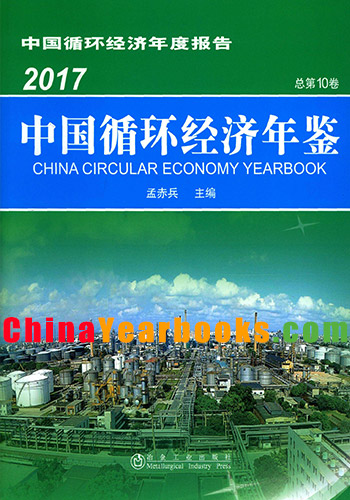
Yearbook title:中国循环经济年鉴2017
Yearbook English title:China Circular Economy Yearbook 2017
Publisher : Metallurgical Industry Press
Published Date : 4/2018
Frequency : Annually
Language : Chinese
ISBN/ISSN : 978-7-5024-7673-1
Availability : Printed Version;Electronic Version(PDF)
China-Circular-Economy-Yearbook-2017
The Chinese Circular Economy Yearbook is a large-sized reference book tocomprehensively record recycle economy history in our country.It adheres to the philosphy ofgreen growth proposed by the general secretary of the CPC Central Committee Xi Jinping andpromotes green growth,circular economy,low carbon economy,the consrtuction of ecologicalcivilization and bertuful China. Since Chinese Circular Economy Yearbook is published for the first time in 2008,it isalways welcomed and praised.Those compliments strongly encourage us to keep makingendeavors to edit Chinese Circular Economy Yearbook. The Chinese Circular Economy Yearbook 2017 records the development of ChineseCircular Economy in 2016 with the text mode combining with articles,entries,forms andpictures. The Chinese Circular Economy Yearbook 2017 has some distinct characteristics,such asall the affairs,information,data,materials and pictures inside coming from official resourcesor publications with authority and reality;It is comprehensive,systematic and full contentcovers from the central government to local government and enterprises,industrial parks,every industries,areas,speeches,important events and affairs,laws,policies,sciences andtypical cases;It involves in every aspects of the recycle economy from different levels and allorientations;It collects nearly portraying the recycle economy in our country and hence it isinteresting to see and read. The Chinese Circular Economy Yearbook 2017 records experiences from recycle economyexperimental units which enhances its reference value. During the edition of the Yearbook,it is highly appreciated for the strong support fromthe ministries and commissions of the State Department,every province,cities,municipalitiesand cities specifically designated in the state plan,Guiyang City,the Development andReform Commission of Xinjiang Production and Construction Corps of CPLA,every nationalimportant industries and their associations,recycle economy experimental units. The newsroom of the Yearbook is located in Beijing Modern Recycle Economy Academy(010-84119310,[email protected]). Due to limited experiences and level,please don’t hesitate to let us know if there’s anyomission and error.
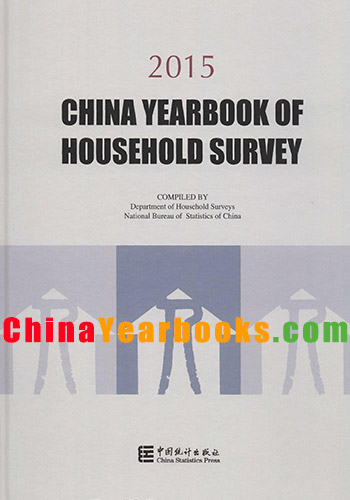
Yearbook title:中国住户调查年鉴(英文版)2015
Yearbook English title:China Yearbook of Household Survey 2015
ISBN:978-7-5037-7702-8
Editorial institution: Survey Office of the National Bureau of Statistics
Language: English
Publisher: China Statistics Press
Availability : Printed Version;Electronic Version(PDF)
China Yearbook of Household Survey 2015
2015 China Yearbook of Household Survey is an annual statistical publication whichreports income,expenditure and living conditions of households nationwide as well asby urban/rural,province,income quintile and economic region.It also provides basicstatistics of farm household investment in fixed assets and rural poverty,labor migra-tion profile and other data gained from Household Survey. The data of 2013 and after in this yearbook originate from Integrated Household Surveyof Income,Expenditure and Living Conditions implemented since 2013.The data priorto 2012 originate from Urban Household Survey and Rural Household Survey separatelyconducted,and are aggregated according to the scheme of Urban Household Surveyand Rural Household Survey correspondingly.The information of Hong Kong SpecialAdministrative Region,Macao Special Administrative Region and Taiwan Province arenot included. The book includes an Introduction to Household Surveys of China and seven parts oftables:(1) Income and Expenditure of Households Nationwide,2013-2014;(2) Incomeand Expenditure of Households by Province,2013-2014;(3) Income and Expenditureof Urban and Rural Households for Selected Years;(4) Basic Statistics by Groups ofUrban and Rural Households,2005-2012;(5) Income and Expenditure of Urban andRural households by Province,2005-2012;(6) Basic Statistics of Farm HouseholdInvestment in Fixed Assets in Rural Area;(7) Other Statistics from Household Surveys. Statistical discrepancies due to rounding are not adjusted in this yearbook. The notes concerning the whole table are placed at the beginning of the table,while thenotes concerning individual indicators are placed at the end. Notations used in this yearbook: “…”data are not available; “#”major items; “*”see footnotes below”.
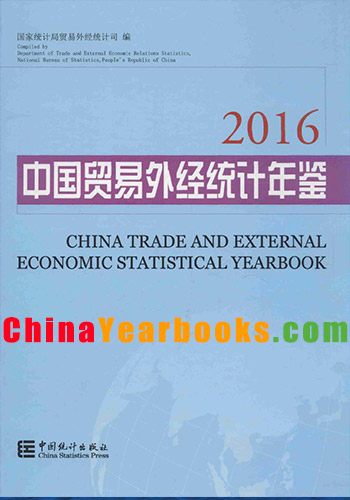
China Trade And External Economic Statistical Yearbook 2016 Download
Publisher : China Statistics Press Published Date : 11/2016 Frequency : Annually Language : English and Chinese bilingual ISBN/ISSN : 978-7-5037-8036-3 Weight : 2.60kg Availability : Printed Version;Electronic Version(PDF)
China Trade And External Economic Statistical Yearbook 2016
Ⅰ.2016 China Trade and External Economic Statistical Yearbook reflects the situation of China in the development of the domestic and foreign trade,the external economic transactions and the tourism synthetically.The yearbook covers the main data of the domestic trade,the foreign trade,the external economic transactions and the tourism of China in 2015,and embodies the data from national level and all the provinces,autonomous regions and municipalities.It also lists the time series relative data of important indicators by years. Ⅱ.The yearbook contains the following 9 chapters:1.Integration;2.Consumer Market;3.Wholsale and Retail Trades;4.Hotels and Catering Services;5.Balance of Payments;6.Foreign Trade;7.Foreign Capital;8.International Cooperation;9.Tourism.In addition,Explanatory Notes on Main Statistical Indicators are provided at the end of book. Ⅲ.The national data in the book do not include that of Hongkong Special Administrative Region,Macao Special Administrative Region and Taiwan Province. Ⅳ.The major sources of data except these in the domestic trade are the regular statistical reporting forms provided by sectors such as the Ministry of Public Security,the Ministry of Commerce,the General Administration of Customs,the State Administration of Industrial & Commerce,the General Administration of Travel and Tourism,the State Administration of Foreign Exchange.The book is edited by the Department of Trade and External Economic Relation Statistics of the National Bureau of Statistics.Since the functions of sectors mentioned above are different,the requirement,the scope,the calculating specification and the method of statistics are not in the same,and some of the figures may not be in conformity.Readers who want to use the data please consult the explanatory note. Ⅴ.The units of measurement used in this yearbook are internationally standard measurement units. Ⅵ.Notations used in the yearbook:(blank space) indicates that the figure is not large enough to be measured with the smallest unit in the table,or data are unknown or are not available;”#” indicates a major breakdown of the total;and “*” or “①” indicates footnotes at the end of the table. Ⅶ.The data belong to 2015 in the table of without year in the yearbook.
Publisher : Metallurgical industry press
Published Date : 4/2018
Frequency : Annually
Language : Chinese
ISBN/ISSN : 978-7-5024-7672-4
Availability : Printed Version;Electronic Version(PDF)
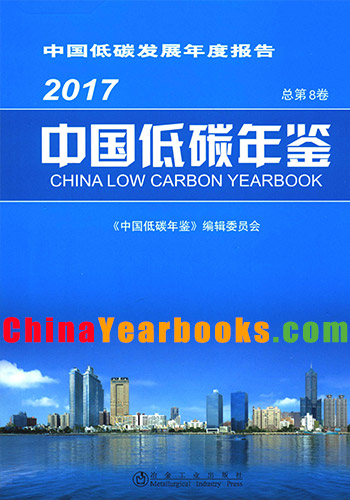
China-Low-Carbon-Yearbook-2017
Climate change relates to the long-term interests of Chinese nation and all mankind,so taking the low-carbondevelopment way is an urgent demand to actively respond to climate change,an embodying in the direction of People First,Overall Coordination and Sustainable Development,and also the inherent and objective requirement of building an innovativecountry as well. It has already became a China’s basic state policy and incorporated into Twelfth Five-Year Plan for National Economicand Social Development of People’s Republic of China to establish green low-carbon development concept,to stronglydevelop green economy with the connotation of low-carbon emissions and recycling usage,and to radually set up the industry,construction and transportation systems with low-carbon emission and low-carbon social life,and to actively explore thelow-carbon development road with Chinese characteristics,and to effectively control greenhouse gas emissions,as wellas to positively contribute to promoting sustainable development of both China and the world. For the purpose of comprehensively recording the course and actual situation of Chinese low-carbon development,and speeding up the low-carbon development,China Low-Carbon Yearbook was specially published. Great attention and firm support were given from all involved parties such as from the central to locals,eachnational key industry and its association,and the low-carbon pilot and practice units.The consultants and editors wereinvited from the relevant ministries and commissions(bureaus) of National People’s Congress and the State Council,andthe provincial and municipal National Development and Reform Commission,and relevant experts and scholars.All ofthem positively wrote and provided manuscripts,the information and pictures,and gave many guidance suggestions.Allmentioned above encouraged and spur us to make great efforts to edit China Low-Carbon Yearbook 2015 well. China Low-Carbon Yearbook 2017 basic content focuses on China low-carbon development status and actions in dealingwith climate change,important information/data,experience and major a chievement in 2016.To improve the timeliness ofChina Low-Carbon Yearbook,we collected important policy documents and related contents referring to China’s actions indealing with climate change and low carbon development in 2017. The Deng Xiaoping Theory and Three Representative Important Thought were adhered to and followed,andScientific Development Outlook was applied and implemented during editing of China Low-Carbon Yearbook 2016,whichcombined articles,items,statements and pictures in style,Fully implement the spirit of a series of speeches about greengrowth concept and the construction of ecological civilization by Xi Jinping. China Low-Carbon Yearbook 2017 has some obvious features as follow:Efforts to strengthen the comprehensiveanalysis of income of the National Development and Reform Commission issued the “China’s National Climate ChangePolicy and Action Annual Report”,invite the relevant ministries and commissions of the State Council,key industries andareas,provinces,experts authored papers and other climate change and low carbon development and thematic developmentreport,which greatly enriched the “Yearbook” content,and enhance the “Yearbook” readability,use value and historicalvalue.The incidents,information,data,materials,pictures and etc.recorded are all from the official and open publicationswith authority and authenticity,which have high historical value,and high storage,usage and reference values;contentscovered are more comprehensive,broad and systematic,from the central to locals,so as enterprises,parks,each industryand field,speech and views,major activities and events,regulations,policies,science and technology,and typical cases andforeign profiles,involving each aspect of low-carbon development at multi-level and all-dimension.The book with more than2 million characters is rear before owing to its large scale and rich,accurate and complete content;excellent pictures andtexts,with strong visibility,vitality and readability. China Low-Carbon Yearbook is supported by grants project of China Clean Development Mechanism Fund. Sincerely thanks to the related ministries and commissions(bureaus) of National People’s Congress and the State Council,every provinces and cities,the national key industries and their associations,low-carbon pilot and practice units,expertsand scholars etc.for their supports in the editing and publishing of China Low-Carbon Yearbook 2016. We are of inexperience and of limited level,for the omissions and errors existing in the book,please point out withoutstint.
The Yearbook of China Tourism Statistics for 2016 PDF download
The Yearbook of China Tourism Statistics for 2016 is a yearly review with infomation on the overall development of the tourism industry in the People’s Republic of China in 2015。Written in English and Chinese, the information in this Yearbook covers nine aspects: Statistics Report on China’s Tourism Industry in 2015 and visitor
arrivals to China, major profile of international visitors to China, international tourism receipts, domestic tourism, business of different regions, business of star-rated hotels, business of travel agencies. business of A一Qrade tourist attractions, travel enterprises and non-business institutions.
A note to the Index of Major Statistic Terms is attached at the end of the Yearbook, which gives a brief explanation of the meaning of main tourism statistics, scope and method of data-collecting. The data of the Yearbook come from the tourism departments,statistical departments, and ports of entry and exit of public security departments throughout the country. The statistics of Taiwan Province, Hong Kong Special Administrative Region and Macao Special Administrative Region are not included. All the data are processed and compiled in line with the requirements set forth in the tourism statistics reporting system jointly formulated by the National Tourism Administration and the National Bureau of Statistics, and explanatory notes are provided in some special cases.
Inbound visitor samples include inbound visitors from foreign countries, Hong Kong SAR, Macau SAR and Taiwan province while their stay time is less than 3 months. Re一check and re一adjustments have been made to the figures of each month in 2015,and if some inconsistency is found between the published figures and the figures in this Yearbook, the latter should be taken as authentic.
This Yearbook provides authoritative data on the development of China’s tourism industry in 2015,which is useful to tourism departments, relevant departments of the national economy, education and research institutes, and students and teachers.The
overseas travel trade, relevant people of the industry and foreign visitors to China, compatriots from Hong Kong, Macao and Taiwan can also benefit from this Yearbook.
In the Yearbook. wherever a table is contiuned on the next page, footnotes are given on the first page. The mark“#‘“denotes headline entry, while the mark“*” leads to footnotes. A blank cell means relevant data unclear or the relevant figure for previous years not available. Sources of the data are acknowledged beneath the table.
All the unacknowledged data are provided by the National Tourism Administration.
Editing Committee of
the Yearbook of China Tourism Statistics
Publisher : China Statistics Press Published Date : 12/2017 Frequency : Annually Language : English and Chinese bilingual ISBN/ISSN : Availability : Printed Version;Electronic Version(PDF)
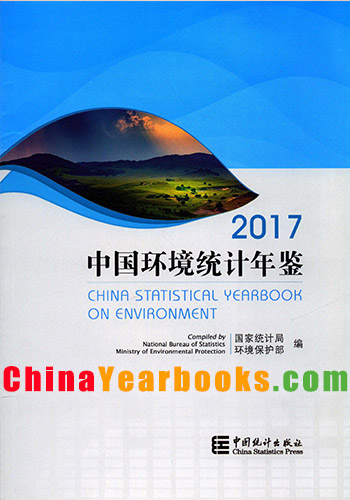
China Statistical Yearbook on Environment-2017
I. China Statistical Yearbook on Environment -2017 is prepared jointly by the National Bureau
of Statistics, Ministry of Environmental Protection and other ministries. It is an annual statistics
publication, with comprehensive data in 2016 and selected data series in major years at national level
and at provincial level (province, autonomous region, and municipality directly under the central
government) and therefore reflecting various aspects of China’s environmental development.
II. China Statistical Yearbook on Environment -2017 contains 12 chapters: 1. Natural Conditions;
2. Freshwater Environment; 3.Marine Environment; 4. Atmospheric Environment; 5. Solid Wastes;
6. Natural Ecology; 7. Land Use; 8. Forestry; 9.Natural Disasters&Environmental Accidents;
10. Environmental Investment; 11 .Urban Environment; 12. Rural Environment. Five appendixes
listed as Main Indicators of Population, Resource and Environment; Main Resources& Environmental
Indicators in the 13t” Five-year Plan; Main Environmental Indicators by Eastern, Central and Western;
Main Environmental Indicators of the World’s Major Countries and Regions; Explanatory Notes on
Main Statistical Indicators.
III. Due to the adjustment of the environmental statistical methodology, the Ministry of
Environmental Protection has delayed releasing the environmental statistics of 2016, which is scheduled
to be released simultaneously with that of 2017.
IV The national data in this book do not include that of Hong Kong Special Administrative Region,
Macao Special Administrative Region and Taiwan Province except for territory and forest resources.
The information gathered from the State Forestry Administration. Daxinganling is affiliated to the State
Forestry Administration, tied with the provinces, autonomous regions, municipalities under the central
government, without duplication of data.
V Notations used in this book:
“(blank)”indicates that the data are not available;
“#”indicates the major items of the total.
VI. The institutions participating in the compilation of this publication include: Ministry of Water
Resource, Ministry of Housing and Urban-Rural Development, Ministry of Land and Resource, Ministry
of Agriculture, National Health and Family Planning Commission, Ministry of Civil Affairs, Ministry
of Transport, State Forestry Administration, State Oceanic Administration, China Meteorological
Administration, China Earthquake Administration. We would like to express our gratitude to these
institutions for their cooperation and support in preparing this publication.
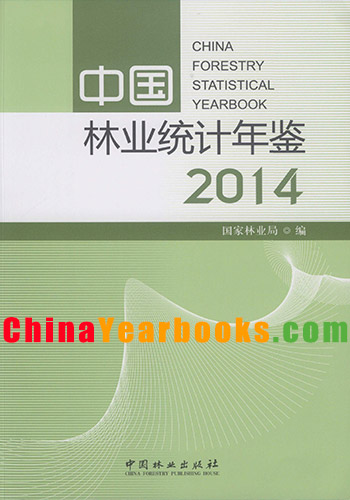
Publisher : China Forestry Press Published Date : 09/2015 Frequency : Annually Language : Chinese ISBN/ISSN :978-7-5038-8134-3 Availability : Printed Version;Electronic Version(PDF & EXCEL)
China Forestry Statistical Yearbook 2017
“China Forestry Statistical Yearbook 2014” in order to meet the needs of reform and opening up, from home and abroad to facilitate the understanding of Chinese forestry construction and development, “China Forestry Statistical Yearbook” Our editors published since 1987, an annual publication of a book, for readers used as a tool informative.
“China Forestry Statistical Yearbook 2014” book, according to the Department of provinces, autonomous regions, municipalities directly under the forestry administrations and units directly under the State Forestry Administration of Forestry Statistics reported in 2014 annual reports and other relevant information compiled from. The book is divided into: forest and wetland resources, ecological construction, industrial development, Employment and Earnings, forestry investment and forestry education section 6 and 135 state-owned forest timber harvesting on Main Statistical Indicators 20 Key enterprises and forest bureau, forestry and rural Woodland workstation basic situation, major forest disaster situations, the National afforestation sub-county, the country’s main statistical indicators for the completion over the years, 2002–2014 main imports and exports of forest products, wildlife imports and exports and the major countries in the world forestry situation 8 appendices.